

Currently Empty: ₹0.00



Blog
The Missing Piece in AI Education: Why Students Must Learn to Think Before They Use AI
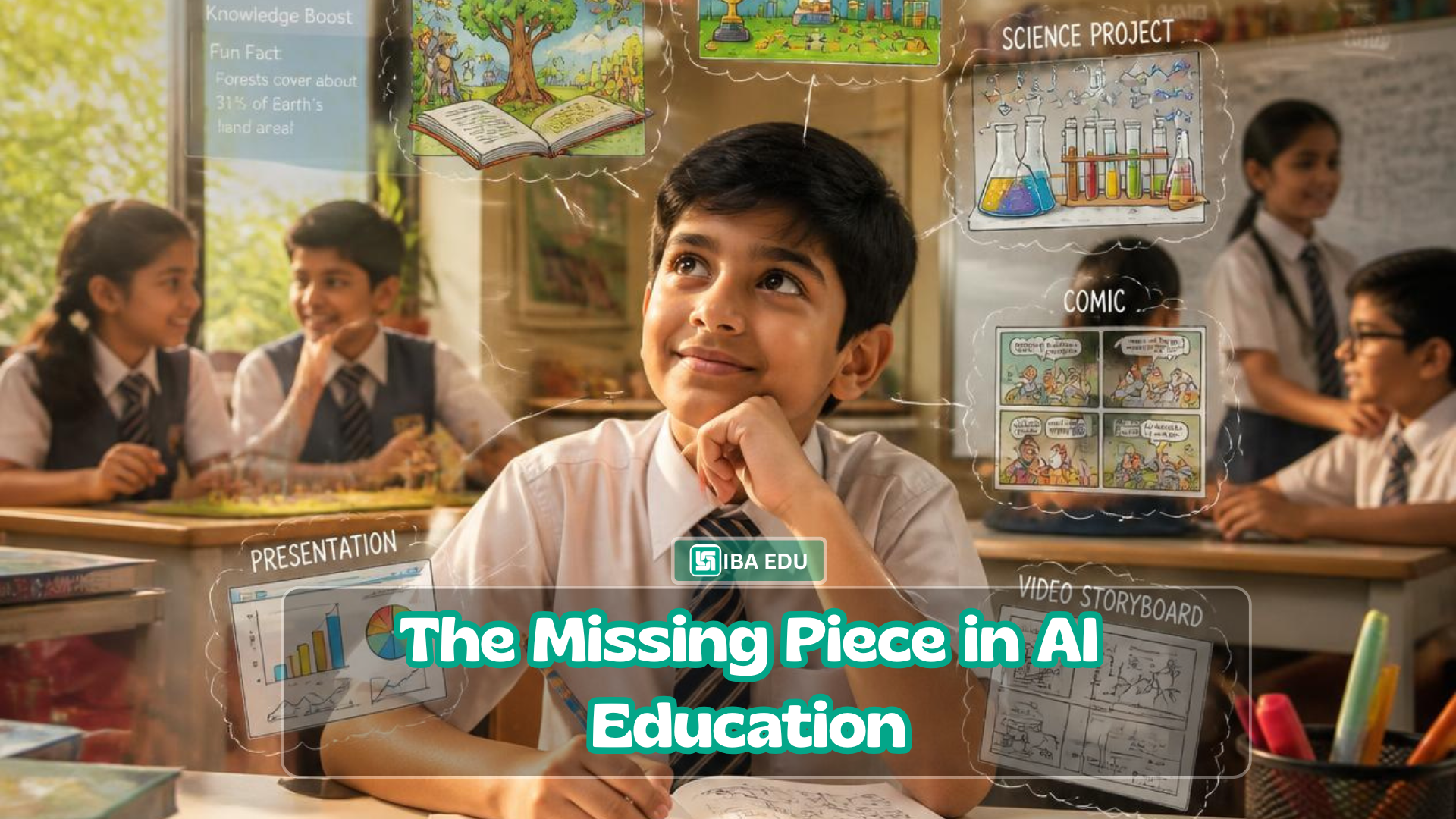
The integration of Artificial Intelligence into our schools is no longer a matter of “if” or “when”—it is happening right now. Across the globe, school principals, academic directors, and education trusts are rushing to implement AI tools, eager to position their institutions at the frontier of innovation. Yet, in this global race toward technological adoption, a critical, foundational element is being overlooked.
We are handing students the most powerful knowledge-generation tools in human history, but we are failing to provide them with the cognitive architecture required to wield them responsibly.
The missing piece in AI education is not better software, faster hardware, or more advanced algorithms. The missing piece is the human mind. If we do not teach students to think critically before they interact with artificial intelligence, we risk raising a generation of passive consumers rather than visionary creators.
This article introduces the Brain-First AI Learning Model—the core philosophy behind the AI Future Creators (AIFC) framework by IBA EDU. It is a strategic, evidence-informed roadmap for school leaders who recognize that true future-ready education must develop human intelligence first and use AI as a powerful creative partner.
1. The AI Revolution in Education
We are experiencing a paradigm shift that dwarfs the introduction of the internet or the personal computer. Artificial Intelligence can synthesize information, draft essays, generate hyper-realistic images, and write complex code in seconds. For education systems traditionally built on the transfer and recall of information, this represents an existential challenge.
When a machine can instantly perform the tasks we have historically used to measure student intelligence, the definition of learning must evolve. The OECD Education 2030 Learning Framework suggests that schools are facing increasing demands to prepare students for rapid changes, jobs that have not yet been created, and technologies that have not yet been invented. Education must equip learners with the agency, competencies, and sense of purpose to shape their own lives.
However, many schools mistakenly equate “AI integration” with simply giving students access to AI chatbots to help with homework or research. This superficial adoption completely misses the transformative potential of the technology and, worse, introduces severe developmental risks.
2. The Hidden Risks of Prompt Dependency
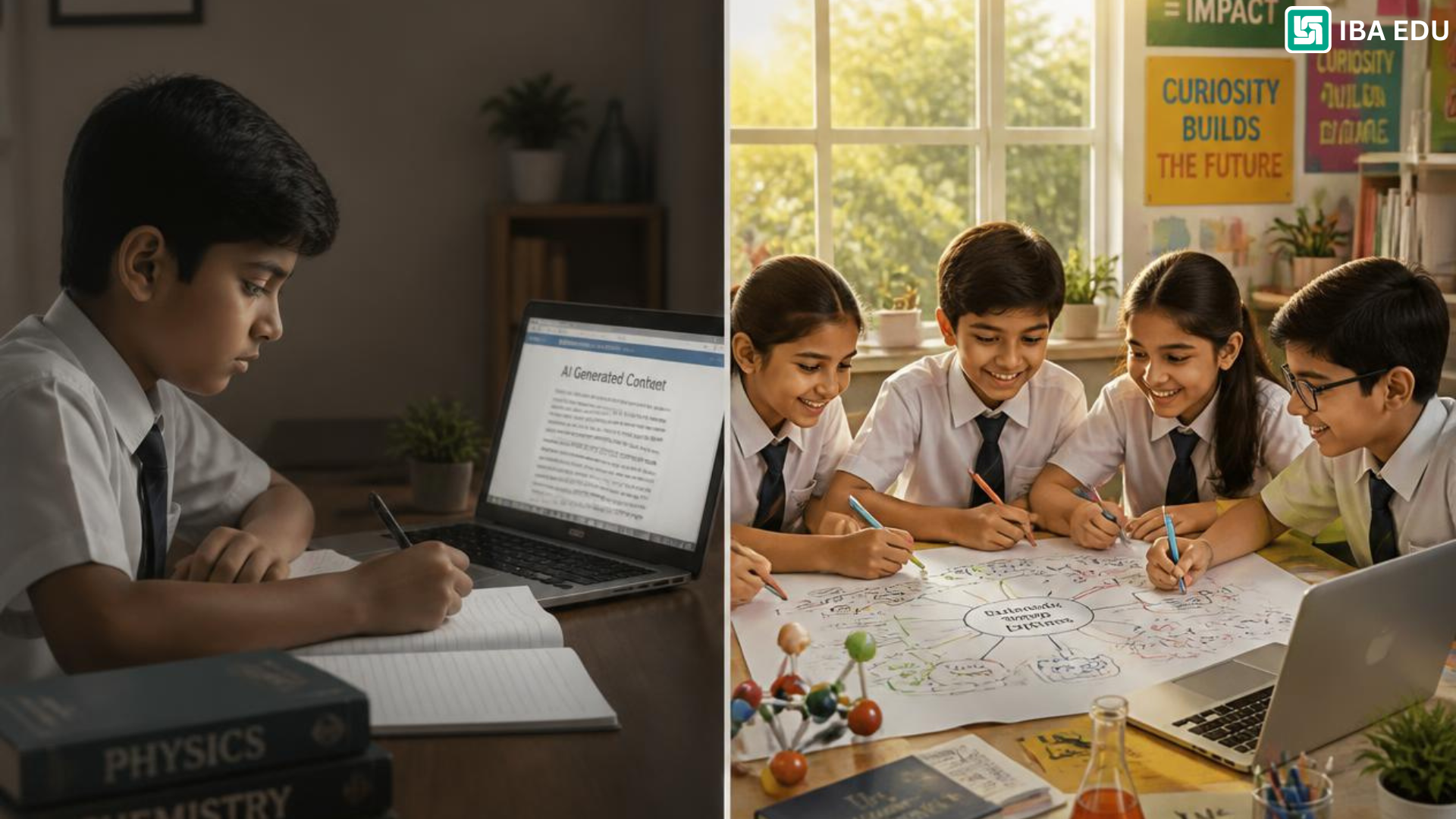
The most urgent threat in the modern classroom is the rise of Prompt Dependency. This occurs when a student outsources their cognitive labor to an algorithm at the first sign of friction, bypassing the fundamental process of learning.
When a student encounters a problem and immediately asks an AI to solve it, they are not learning; they are merely operating a machine. The symptoms of prompt dependency are already visible in classrooms globally:
-
Blank Page Paralysis: An inability to begin a task, brainstorm, or draft an outline without an AI generating the initial ideas.
-
Erosion of Voice: Student submissions become homogenized, adopting the sterile, statistically average tone of large language models, stripping away cultural nuance and personal perspective.
-
The Illusion of Competence: Students believe they understand a concept because they successfully prompted an AI to explain it, yet they fail to retain or apply the knowledge independently.
-
Atrophy of Critical Analysis: A dangerous tendency to accept AI-generated outputs as absolute truth, failing to identify hallucinations, inherent biases, or logical fallacies.
“If we teach students to prompt before we teach them to think, education ceases to be about human development and becomes nothing more than systems management.”
3. Why AI Should Never Replace Human Thinking
Learning is fundamentally a biological and neurological process. It requires “productive struggle”—the friction of grappling with a new concept, making mistakes, and building neural pathways through effort and synthesis. If AI removes this friction, the cognitive muscles atrophy.
AI should never replace human thinking because AI does not “think”; it computes probabilities. It lacks empathy, moral reasoning, lived experience, and genuine imagination. A machine cannot understand the socio-cultural context of a local community problem, nor can it experience the emotional resonance of a beautifully crafted story.
To thrive in the 21st century, students must cultivate the deeply human traits that algorithms cannot replicate. They must learn to use AI to amplify their ideas, scale their solutions, and refine their visions. The goal of education must be cognitive empowerment, ensuring that the student remains the master of the technology, not its servant.
4. The Importance of Brain-First Learning
To counteract the risks of prompt dependency and harness the true power of EdTech innovation for school principals and educators, schools must adopt a Brain-First approach.
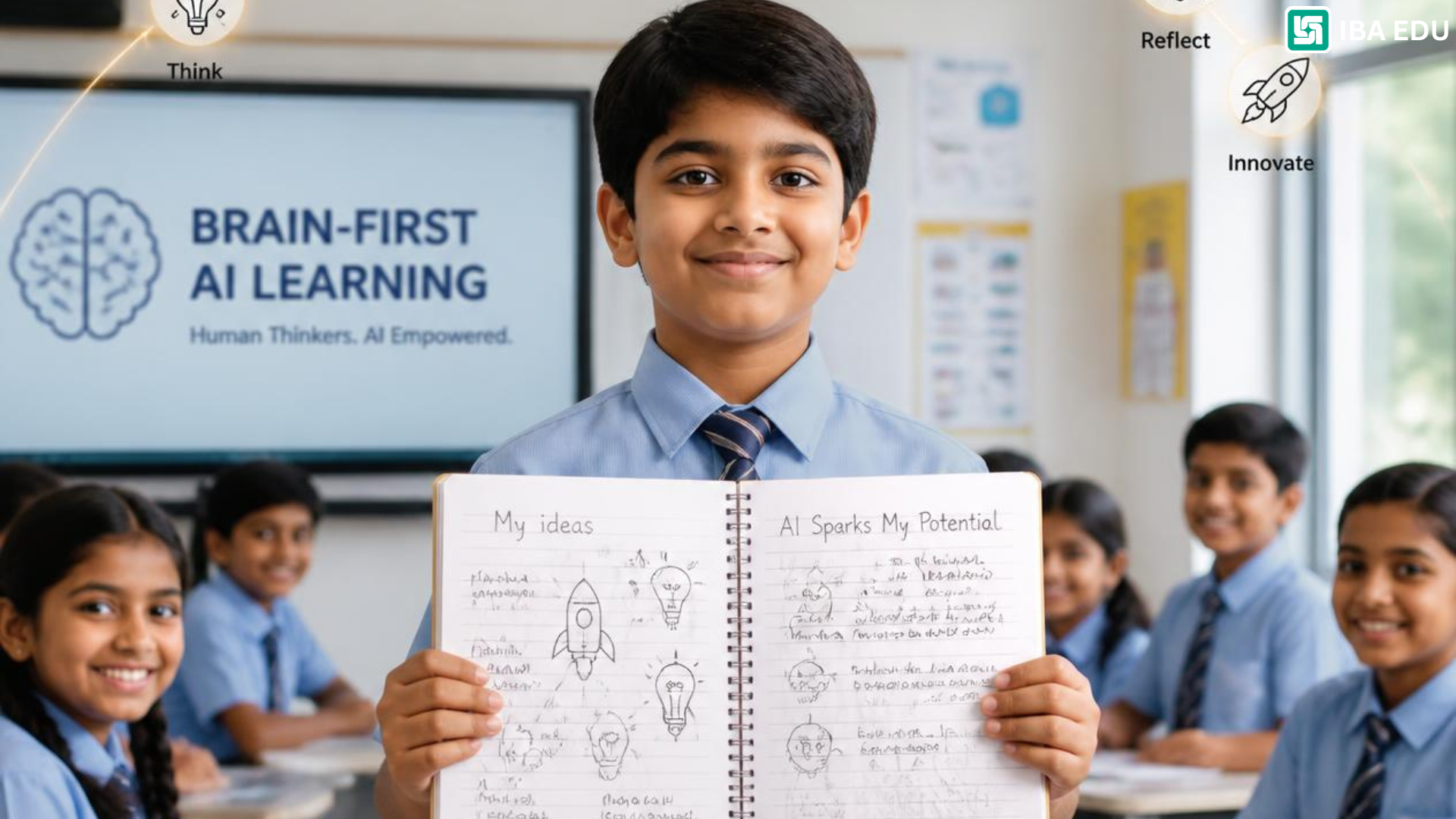
The Brain-First AI learning model operates on a non-negotiable principle: Students must THINK before they PROMPT.
In this model, human curiosity, academic rigor, and creative vision initiate the learning process. The student defines the parameters, establishes the goal, and does the foundational cognitive heavy lifting. AI is only introduced after the student has formulated their ideas, acting as a collaborative partner to enhance, test, or visualize the student’s original thought. This subtle but profound shift in hierarchy changes AI from a crutch into a catapult.
5. The Brain-First AI Learning Framework: A Deep Dive
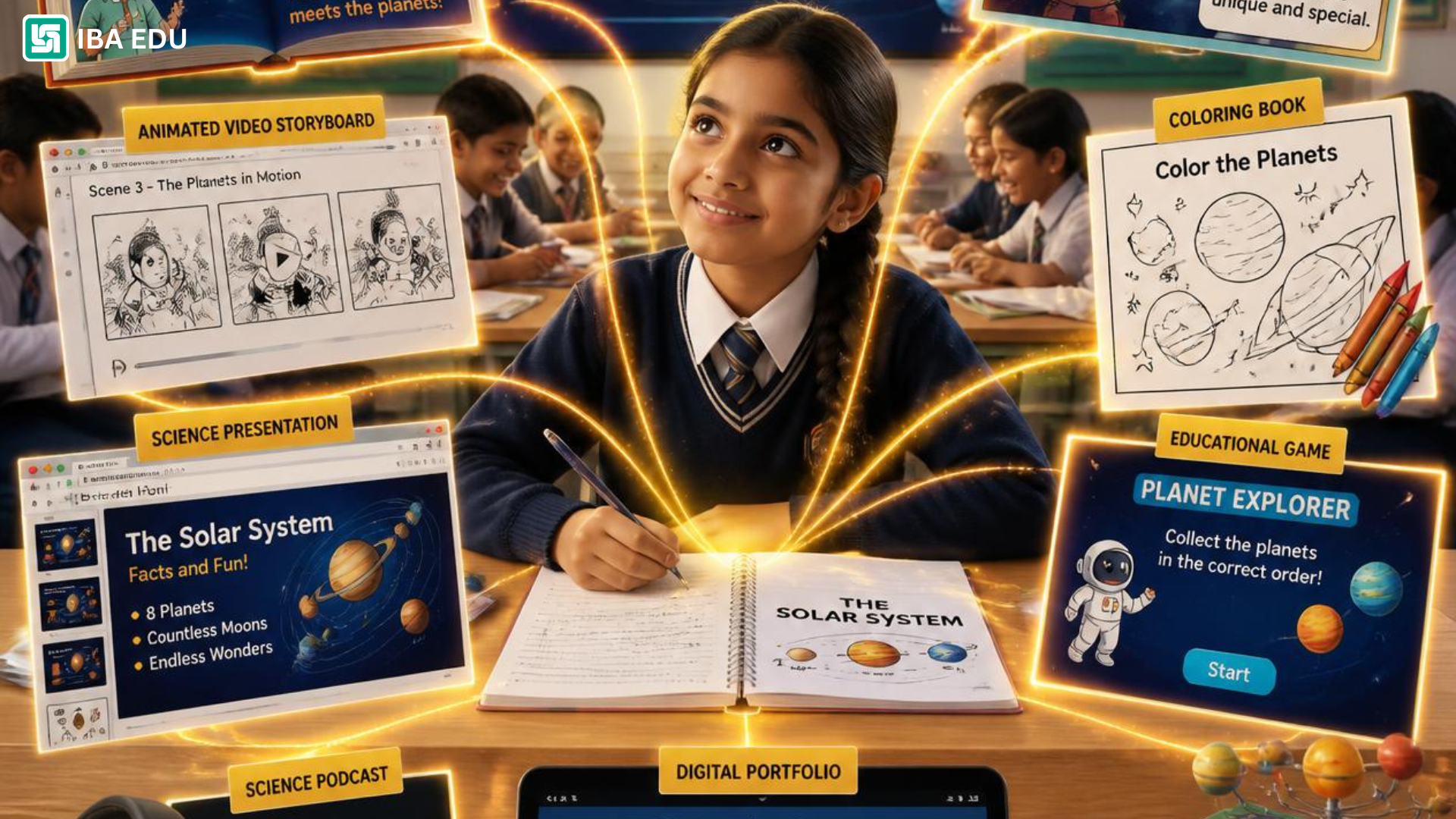
The AI Future Creators (AIFC) ecosystem by IBA EDU operationalizes this philosophy through a meticulously designed 8-stage pedagogical cycle. This framework ensures that AI integration strengthens academic learning rather than distracting from it.
Step 1: Think
The cycle begins with raw human intellect. Students encounter a problem, a core academic concept, or a creative prompt. Devices are closed. Screens are off. Students use their brains to question, analyze, and formulate hypotheses.
Step 2: Understand
Before leveraging technology, students must secure a deep, foundational grasp of the academic subject matter. You cannot effectively prompt an AI to simulate a physics experiment if you do not understand the laws of motion. This stage roots the process in academic rigor.
Step 3: Imagine
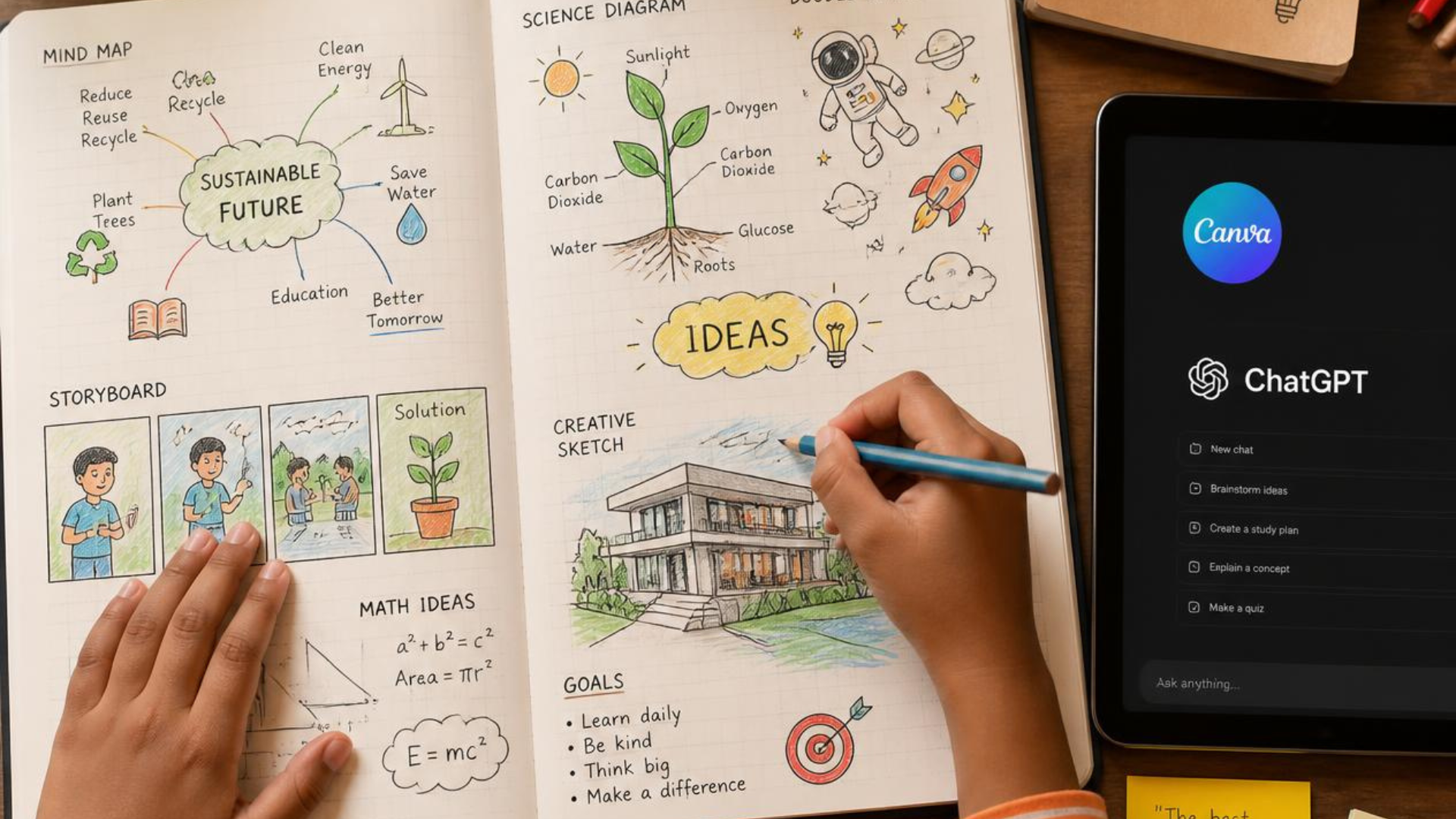
This is the incubation phase. Students brainstorm, storyboard, sketch, and map out their unique approach to the topic. They decide what they want to build—whether it’s a solution to a local environmental issue or the plot of a historical novel.
Step 4: Create
Students build the first draft using their own effort. They write the outline, solve the initial equations, or draw the base designs. The human mind is the primary engine of creation.
Step 5: Enhance with AI
Only at this stage is Artificial Intelligence introduced. Students leverage AI intentionally to elevate their work. They might use a generative language model to critique their debate arguments, a coding assistant to debug their software, or an image generator to bring their hand-drawn sketches to life.
Step 6: Present
Students articulate their journey. They present their final creation to their peers and teachers, specifically defending the creative choices they made and clearly defining how they utilized AI as a tool to achieve their vision.
Step 7: Reflect
A critical metacognitive step. Students analyze the AI’s contribution: What did the AI do well? Where was it inaccurate or biased? How did my original idea change during the collaboration? This stage builds critical thinking in the AI era and ensures responsible AI usage for school students.
Step 8: Innovate
Students take the refined skills, academic knowledge, and technological fluency gained from this cycle and apply them to new, complex, cross-disciplinary challenges.
6. Why Students Must Think Before Using AI
When a student thinks first, they approach the AI interface with a clear, self-directed vision. They are not asking a chatbot, “What should I write about?” Instead, they are commanding the tool: “I am designing a sustainable city model based on my understanding of renewable energy. Here are my parameters. Help me calculate the required solar panel density.”
This positions the student as the CEO of the creative process, treating the AI as a highly capable production assistant. It fosters executive functioning, leadership, and a sense of ownership over the final product.
7. AI Users vs. AI Future Creators
For school management and education trusts, distinguishing between these two outcomes is the key to a successful AI education strategy for school leaders.
| Characteristic | The AI User (Traditional Model) | The AI Future Creator (AIFC Model) |
| Initial Action | Opens an AI tool to seek an answer. | Brainstorms on paper or a whiteboard. |
| Relationship to Tech | Dependent; passive consumer. | Empowered; active director. |
| Output Quality | Generic, derivative, average. | Highly personalized, unique, authentic. |
| Handling Inaccuracies | Accepts AI hallucinations as fact. | Critiques, edits, and guides the AI. |
| Core Skill Developed | Basic software operation. | Critical thinking, vision, and leadership. |
8. Transforming Curriculum into Creative Experiences
The IBA EDU AIFC program seamlessly integrates into existing school frameworks, transforming rote memorization across all subjects into dynamic, creative application.
-
Science: Instead of memorizing the digestive system, students Understand the biology, Imagine a microscopic submarine journey through the body, write the script, and Enhance with AI to generate an educational video animation, complete with their own voiceover explaining the scientific processes.
-
Mathematics: To grasp statistics and probability, students don’t just solve worksheets. They Think about a real-world scenario (e.g., managing a sports team’s budget), build the mathematical model, and use AI data visualization tools to present an interactive dashboard of their findings.
-
English & Languages: Grammar and narrative structure are taught by having students author their own digital books or comics. They Create the plot and dialogue, then partner with AI to generate a cohesive visual aesthetic for their story, publishing a digital portfolio of their literary work.
-
Social Science: History is brought to life when students research a historical event and write a script for a podcast. They use AI voice cloning to simulate interviews with historical figures, rigorously ensuring the AI’s dialogue aligns with primary historical sources they have studied.
-
EVS (Environmental Studies): Students transition from learning about pollution to becoming advocates. They sketch local environmental solutions and use AI to transform their ideas into interactive educational games or printable coloring books designed to teach younger students about sustainability.
9. What a Brain-First Classroom Looks Like
The Primary School Classroom (Grades 1-4)
In a Brain-First primary classroom, the focus is on wonder and tactile discovery.
Scenario: During an EVS lesson on the solar system, 8-year-olds use clay to sculpt their own imaginary planets, defining the gravity and atmosphere. Only after they have physically built and named their planets does the teacher project an AI tool on the smartboard, allowing the children to prompt the AI to generate a realistic space rendering of their specific clay models. The magic of technology is used to celebrate their human creativity.
The Middle School Classroom (Grades 5-8)
In middle school, the focus shifts to systems and collaborative problem-solving.
Scenario: A group of 12-year-olds are studying civics and urban planning. They stand around a whiteboard, intensely debating the layout of a new town to minimize traffic and maximize green space. They calculate areas and draw flowcharts by hand. Once the blueprint is solidified, they use AI architectural software to render 3D models of their city, using AI to test how their road network handles simulated rush-hour traffic.
The Secondary School Classroom (Grades 9-12)
High school students operate as innovators and researchers, preparing for higher education and the workforce.
Scenario: A 16-year-old physics student is developing a prototype for an affordable water filtration system. They research the chemical properties of different filters, sketch the design, and write the initial code for a monitoring sensor. They then engage an advanced AI language model as a sparring partner, prompting it to critique their design from an engineering perspective, identify potential failure points, and suggest coding optimizations before they build the physical prototype.
10. Strengthening Academic Performance
A common apprehension among parents and school owners is that focusing on creativity and technology might dilute academic rigor. The Brain-First AI Learning Model actively strengthens academic performance.
Because students must accurately direct the AI to produce specific outputs, they are forced to master the domain vocabulary and underlying concepts. A student cannot prompt an AI to generate a historically accurate image of the Indus Valley Civilization if they have not deeply studied its architecture, clothing, and geography. The desire to create a spectacular final product acts as a powerful intrinsic motivator, driving students to engage deeply with the textbook material.
11. The Evolving Role of Teachers in the AI Era
In a world where content is abundant, the teacher is no longer required to be the sole dispenser of knowledge. This is not a diminishment of the educator’s role; it is a profound elevation.
In the AIFC ecosystem, teachers become Facilitators of Creativity, Critical Inquiry, and Ethics.
-
They design the cognitive challenges that spark the learning cycle.
-
They guide students through the productive struggle of the “Think” and “Create” phases.
-
They model how to question AI outputs, teaching students to spot bias and inaccuracies.
-
They focus on the emotional and moral development of the child—areas where AI has zero capability.
By utilizing AI for administrative tasks and lesson planning, teachers recover the time and energy needed to focus on what truly matters: mentoring the human beings in their classroom.
12. Why School Leaders Should Rethink AI Education
For school principals, chairpersons, and academic directors, the integration of AI is a defining strategic moment. Adopting a reactive “wait and see” approach will leave your institution behind, as AI literacy rapidly becomes a baseline expectation for university admissions and future careers.
Conversely, allowing unregulated, pedagogy-free AI use in classrooms will lead to a crisis of academic integrity and declining student engagement.
By proactively adopting a Brain-First AI learning model, school leaders establish their institutions as pioneers of a future-ready school curriculum. It signals to parents that the school is not just chasing tech trends, but is deeply committed to protecting and enhancing the cognitive development of their children.
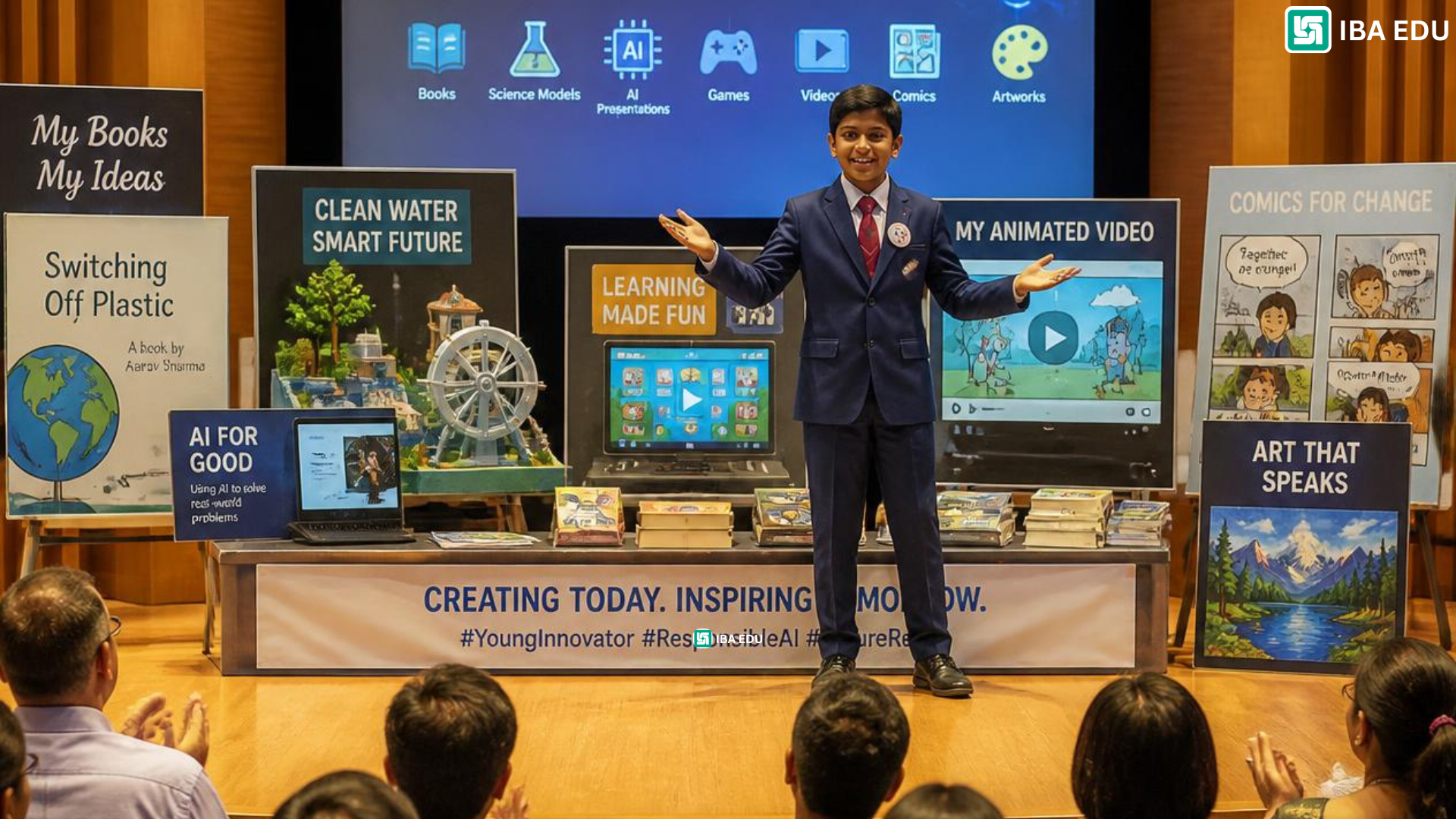
13. How the AI Future Creators (AIFC) Ecosystem Supports Schools
IBA EDU has designed the AI Future Creators (AIFC) program to provide schools with a complete, end-to-end ecosystem for safe, pedagogical AI integration.
The AIFC framework is not a software subscription; it is an educational transformation. It provides:
-
Curriculum Integration: Detailed lesson plans that weave the Brain-First model into standard academic subjects.
-
Teacher Empowerment: Comprehensive professional development, ensuring educators are confident and capable facilitators.
-
Student Portfolios: Systems for students to build verifiable, AI-enhanced digital portfolios that showcase their unique intellectual property.
-
Ethical Guidelines: Robust frameworks for responsible AI usage, data privacy, and academic integrity.
14. Alignment with NEP 2020 Competencies
For Indian educational institutions, the Brain-First AI model is deeply aligned with the mandates of the National Education Policy 2020. NEP 2020 emphasizes the integration of emerging technologies like Artificial Intelligence to develop essential skills at all levels. Under Para 4.24, the policy envisages concerted curricular and pedagogical initiatives, including AI, to foster these competencies.
Furthermore, the National Curriculum Framework for School Education (NCF-SE) 2023 views AI as a core 21st-century skill, focusing on computational thinking and problem-solving. The AIFC program embodies these directives by moving away from rote memorization toward experiential, competency-based learning, ensuring students are equipped for a fast-changing job market.
15. A Compelling Vision for the Future
The future belongs to those who can think deeply, imagine vividly, and collaborate seamlessly with advanced technologies. If we want our students to be the architects of tomorrow, we must provide them with an educational foundation that values human intellect above all else.
We must build schools that produce thinkers, creators, innovators, and responsible AI citizens. We must teach them that technology is a canvas, but the human mind is the artist.
The missing piece in AI education is not the algorithm; it is the intellect.
Is your school prepared to lead the next era of education?
Transform your classrooms, empower your teachers, and equip your students for the future by implementing the Brain-First AI Learning Model.
Partner with IBA EDU and introduce the AI Future Creators (AIFC) program to your institution today.
