Currently Empty: ₹0.00



Blog
Why AI Alone Won’t Prepare Students for the Future: Introducing the Brain-First AI Learning Model for Schools
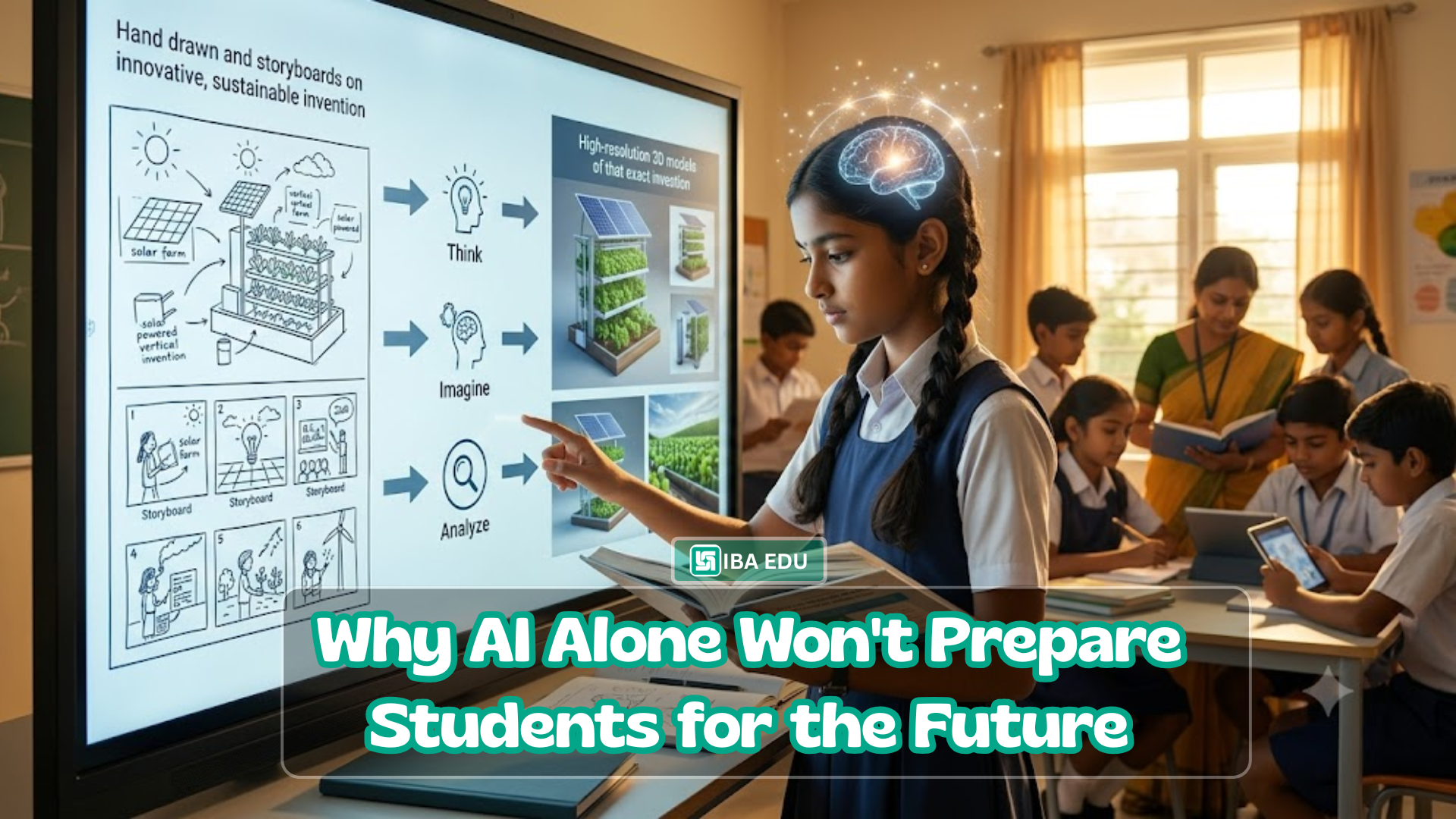
The integration of Artificial Intelligence in education is no longer a distant theoretical concept—it is the reality of classrooms today. Across the globe, school leaders, academic directors, and policymakers are racing to bring AI tools into their institutions. But amidst this technological gold rush, a fundamental question is being overlooked: Are we teaching students how to think with AI, or are we simply teaching them how to let AI think for them?
In the pursuit of modernizing education, handing a student a powerful generative AI tool without a pedagogical framework is not innovation; it is a profound risk to cognitive development. If students learn to prompt before they learn to think, we risk raising a generation of passive consumers rather than active creators.
For schools that want to lead in the 21st century, the goal cannot just be “AI integration.” The goal must be cognitive empowerment.
Welcome to the philosophy behind the AI Future Creators (AIFC) Program by IBA EDU—a revolutionary approach that champions a Brain-First AI Learning Ecosystem. This premium, research-inspired framework ensures that AI serves as a powerful amplifier of student intellect, not a replacement for it.
1. The Future of Education in the AI Era
We are standing at the precipice of the most significant educational paradigm shift since the invention of the printing press. In the AI era, knowledge is no longer a scarce resource; it is infinitely abundant and instantly accessible. The traditional educational model—built on the transfer, memorization, and standardized recall of information—is rapidly becoming obsolete.
In a future where Artificial Intelligence can write essays, solve complex equations, and write code in seconds, what is the value of human education? The answer lies in the deeply human traits that algorithms cannot replicate: empathy, moral reasoning, complex problem-solving, lateral thinking, and raw, unbridled imagination.
The futuristic school of 2030 and beyond will not be judged by how well its students can memorize a textbook, but by how effectively they can leverage advanced technologies to solve real-world problems. The future of education requires an environment where students act as directors, leveraging AI as their production assistant to bring their most ambitious ideas to life.
2. Why AI Alone Is Not Enough
Many schools make the mistake of believing that providing access to AI tools is synonymous with future-readiness. However, AI alone is a raw, undirected capability.
Imagine handing a state-of-the-art power tool to a child who has never learned to build a birdhouse. The tool itself does not impart the knowledge of architecture, design, or safety; without guidance, it is either useless or dangerous. Similarly, an AI interface like ChatGPT or Google Gemini is profoundly powerful, but without a foundational understanding of the subject matter, students cannot evaluate the accuracy, bias, or quality of the AI’s output.
When AI is introduced without a pedagogical anchor, it bypasses the productive struggle that is essential for neurological development. Learning happens in the friction of confusion, the effort of synthesis, and the joy of a hard-earned breakthrough. If AI removes that friction entirely, the cognitive muscles atrophy.
3. The Risks of Prompt Dependency
The most immediate threat facing modern classrooms is the rise of Prompt Dependency.
Prompt Dependency occurs when a student encounters a problem and immediately outsources the cognitive labor to an algorithm before attempting to understand the problem themselves.
The Symptoms of Prompt Dependency:
-
The Blank Page Paralysis: Students cannot begin an assignment without asking an AI to generate the first draft.
-
The Homogenization of Voice: Student writing loses its unique personality, replaced by the sterile, statistically average tone of large language models.
-
Erosion of Critical Analysis: Students accept AI-generated information as absolute truth, failing to fact-check or question the logic.
-
Loss of Creative Confidence: The underlying belief that “the computer is smarter than me,” leading to a reluctance to share original, unpolished ideas.
If we allow prompt dependency to take root, we are not preparing students for the future; we are turning them into mere operators of a machine that will inevitably learn to operate itself.
“AI should enhance student ideas—not replace student thinking. The moment the algorithm works harder than the student, education stops.”
4. Why Thinking Must Come Before Technology
To counter these risks, education must return to its core mandate: developing the human mind. The foundational rule of the modern classroom must be: Students should THINK before they PROMPT.
Thinking is the genesis of all innovation. Before a student opens a laptop or interacts with a chatbot, they must first engage with the material mentally, emotionally, and physically. They must ask questions, formulate hypotheses, and sketch out their creative vision.
When thinking comes first, the student remains the master of the technology. They approach the AI not with a blank mind asking, “What should I do?” but with a clear vision declaring, “Here is what I want to build. Help me scale it, refine it, and polish it.” This subtle shift in hierarchy changes everything. It transforms AI from an automated cheat code into a collaborative cognitive partner.
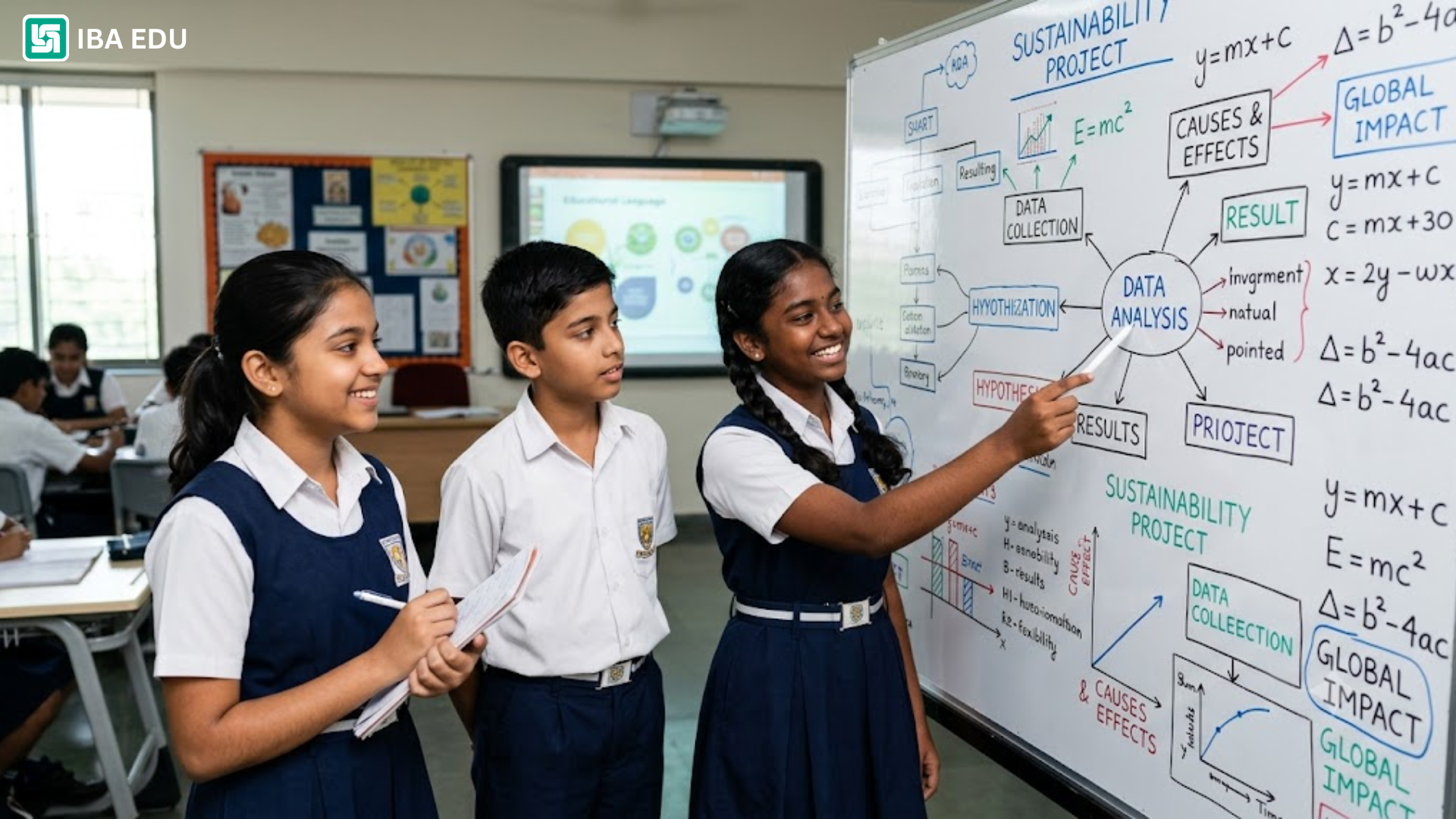
5. Introducing Brain-First AI Learning: The AIFC Methodology
To operationalize this philosophy, IBA EDU has developed the AI Future Creators (AIFC) Program. This program is not just another tech curriculum; it is a holistic, pedagogical ecosystem designed for forward-thinking schools, academic directors, and education trusts.
At the heart of the AIFC Program is the Brain-First AI Learning Cycle, an 8-step framework that ensures technological integration strengthens academic learning rather than bypassing it:
-
Think: The process begins with human curiosity. Students encounter a problem, a prompt, or a concept and engage their raw cognitive faculties.
-
Understand: Students dive into the academic core of the topic, ensuring they grasp the foundational principles before introducing technology.
-
Imagine: This is the creative incubation phase. Students brainstorm, sketch, and storyboard their unique approach to the topic.
-
Create: Students begin drafting their project—be it a story, a science experiment, or a mathematical model—using their own effort and intellect.
-
Enhance with AI: Only now is AI introduced. Students use AI tools purposefully to elevate their creation—seeking feedback, generating illustrations for their stories, testing code, or analyzing data.
-
Present: Students articulate their learning journey, defending their creative choices and explaining how they utilized AI to reach their final outcome.
-
Reflect: A critical metacognitive step where students evaluate what the AI did well, what it got wrong, and how their original idea evolved.
-
Innovate: Students apply this learned cycle to new, complex, real-world problems.
Brain-First AI Learning vs. Traditional AI Usage
| Feature | Traditional AI Usage | Brain-First AI Learning (AIFC) |
| Starting Point | The AI Prompt box | Student brainstorming & storyboarding |
| Role of AI | The Creator / The Answer Key | The Co-Pilot / The Production Assistant |
| Student Mindset | Passive consumer of generated output | Active director of the creative process |
| Output Quality | Generic, homogenized, predictable | Highly personalized, unique, authentic |
| Skill Developed | Basic tool operation | Critical thinking, vision, and leadership |
By embedding this framework, the AIFC program ensures students develop robust Critical Thinking, Creativity, Academic Understanding, Communication Skills, Problem Solving, and Responsible AI Usage.
6. How Every School Subject Can Become Creative
Historically, subjects like Mathematics, Science, and Social Science have been taught through rigid, linear methodologies. The Brain-First AI model shatters these boundaries, operating on the belief that every academic discipline is inherently creative.
When students are freed from the pressure of rote memorization—because AI can provide facts instantly—the classroom becomes a laboratory for application. Instead of asking students to memorize the dates of the French Revolution, a Brain-First classroom asks them to understand the socio-economic drivers and then create a digital newspaper from 1789, using AI to generate historically accurate woodcut-style illustrations to accompany their original journalistic writing.
Every subject transforms from a static body of knowledge to be consumed, into a dynamic toolkit for creation.
7. Transforming the Core Curriculum into Hands-On Creative Experiences
The true power of the IBA EDU AIFC Program lies in its ability to integrate seamlessly with standard school curricula, breathing vivid life into daily lessons. Here is how textbooks are converted into digital portfolios, stories, and games.
🔬 Science: From Diagrams to Discovery
In a traditional science class, students copy diagrams of the water cycle or the human heart. In an AIFC classroom, students Think about the biological processes and Understand the mechanics. Then, they Imagine a journey through the bloodstream. They write the script for an educational explainer video, and finally, they Enhance with AI by using generative video tools to create accurate animations of red blood cells, recording their own voiceovers to explain the science.
📐 Mathematics: From Equations to Environments
Math is often plagued by the question, “When will I ever use this?” Under the Brain-First model, students learning about geometry and area don’t just solve textbook problems. They Think about urban planning. They calculate the area required for a sustainable city block, create the mathematical blueprints, and then use AI image generators to visualize what their mathematically precise eco-city would look like in real life.
✍️ English & Languages: From Essays to Epics
Language arts undergo a beautiful renaissance in this ecosystem. Instead of writing a standard essay, students become published authors. A student Understands the structure of a hero’s journey, Creates an original narrative about a local cultural myth, and then partners with AI to generate a cohesive visual aesthetic for a digital comic book. The AI doesn’t write the story; it acts as the illustrator, allowing the student’s literary voice to shine alongside professional-grade visuals.
🌍 Social Science: From History to Hyper-Reality
History becomes an immersive experience. Students studying ancient civilizations can write scripts for a historical podcast. They use AI voice synthesis to bring historical figures to life, engaging in debates based on primary sources they have researched. They build digital portfolios that serve as virtual museums, curating AI-enhanced artifacts that demonstrate their deep academic understanding of historical contexts.
🌱 EVS (Environmental Studies): From Awareness to Action
Young learners studying the environment don’t just read about endangered species; they become advocates. They write facts about local ecosystems, draw their own interpretations, and use AI to transform their sketches into beautiful, interactive coloring books or digital games that teach other children about recycling and conservation.
8. How AIFC Strengthens Academic Performance
A common concern among school management and parents is that technology distracts from “real learning” and might negatively impact academic scores. The Brain-First AI model does the exact opposite: it serves as a massive amplifier of academic rigor.
When a student knows that their understanding of photosynthesis will be used to program an interactive game or design a digital book, their motivation to master the underlying academic concept skyrockets. They are no longer learning for an exam on Friday; they are learning to execute a creative vision.
Furthermore, to effectively prompt an AI to generate an accurate scientific diagram or historical image, the student must possess the domain vocabulary. You cannot prompt an AI to generate a “mitochondria” if you do not know what it is or what it does. Therefore, the very act of directing the AI requires and reinforces deep academic understanding and precise communication skills.
9. The Role of AI as a Creative Partner
The AIFC program reframes the narrative around AI from one of replacement to one of partnership. We teach students the concept of Co-Intelligence.
In this ecosystem, AI is treated like a highly capable intern. It is fast, it has access to vast amounts of data, and it can execute technical tasks brilliantly. However, it lacks human intuition, lived experience, ethical boundaries, and true visionary creativity.
Students learn that the human mind must serve as the CEO of this partnership. The student sets the goal, defines the parameters, applies the moral compass, and makes the final qualitative judgments. By teaching students to manage AI rather than submit to it, schools foster leadership, executive functioning, and an unshakable sense of creative confidence.
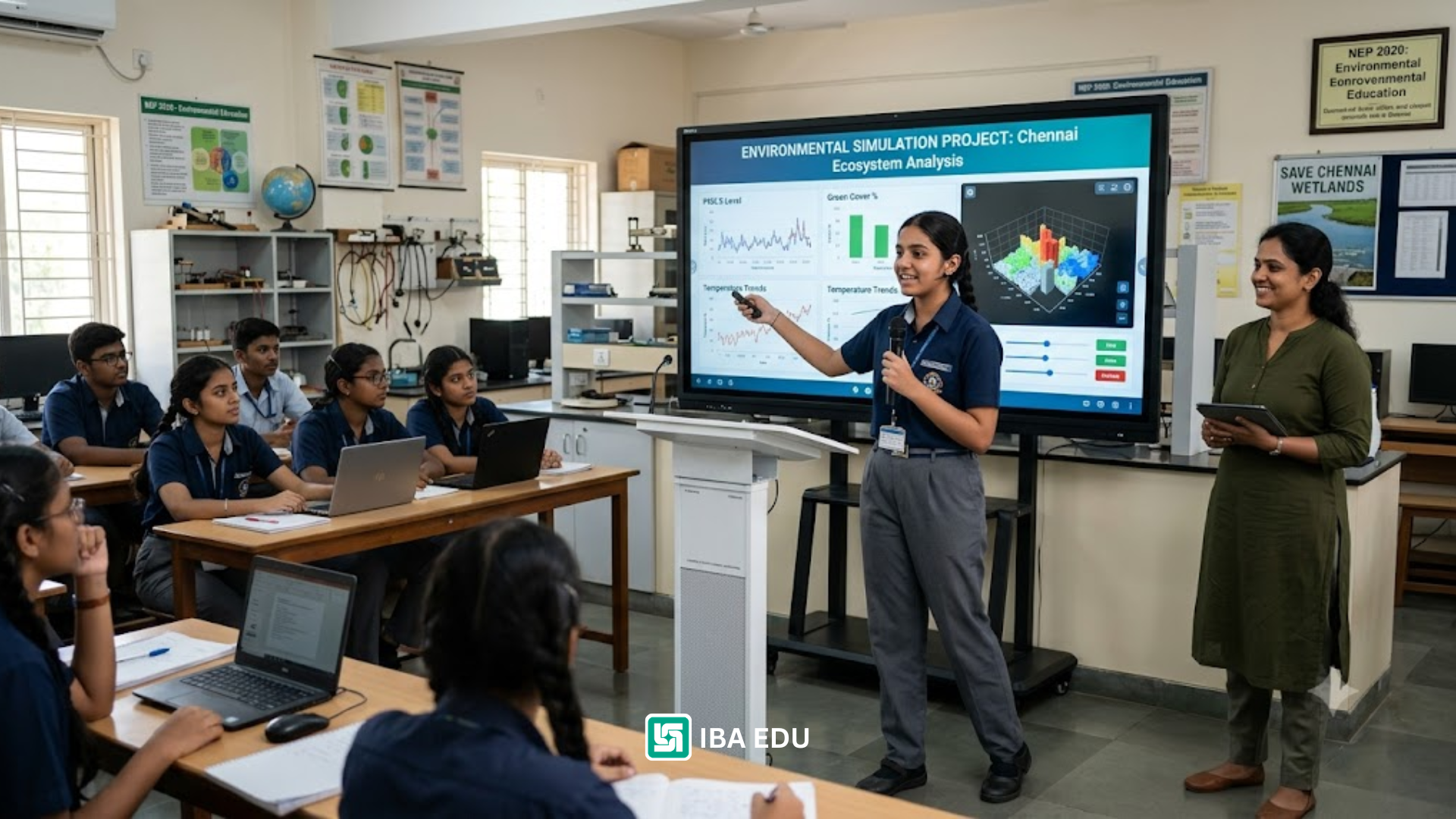
10. The Changing Role of Teachers: Facilitators of Creativity
For a school to successfully implement a future-ready ecosystem, the role of the educator must evolve. The teacher can no longer be the “sage on the stage,” possessing all the answers, because the internet already holds all the answers.
In an AIFC classroom, teachers become Facilitators of Creativity and Critical Inquiry.
-
They don’t just grade the final output; they evaluate the process of how a student reached it.
-
They challenge the AI’s output alongside the students, asking, “Is this accurate? Is it biased? How can we make it better?”
-
They curate the learning environment, providing the academic scaffolding required for students to launch their imaginative projects.
This shift does not diminish the teacher’s value; it elevates it. Teachers are freed from the drudgery of rote instruction to focus on mentoring, guiding moral development, and nurturing individual student talents.
11. What an AIFC Classroom Looks Like
To visualize this transformation, let us look at the Brain-First ecosystem in action across different age groups.
🎒 Primary School (Grades 1–4): Cultivating Wonder
-
The Scene: A bustling classroom where 8-year-olds are learning about habitats.
-
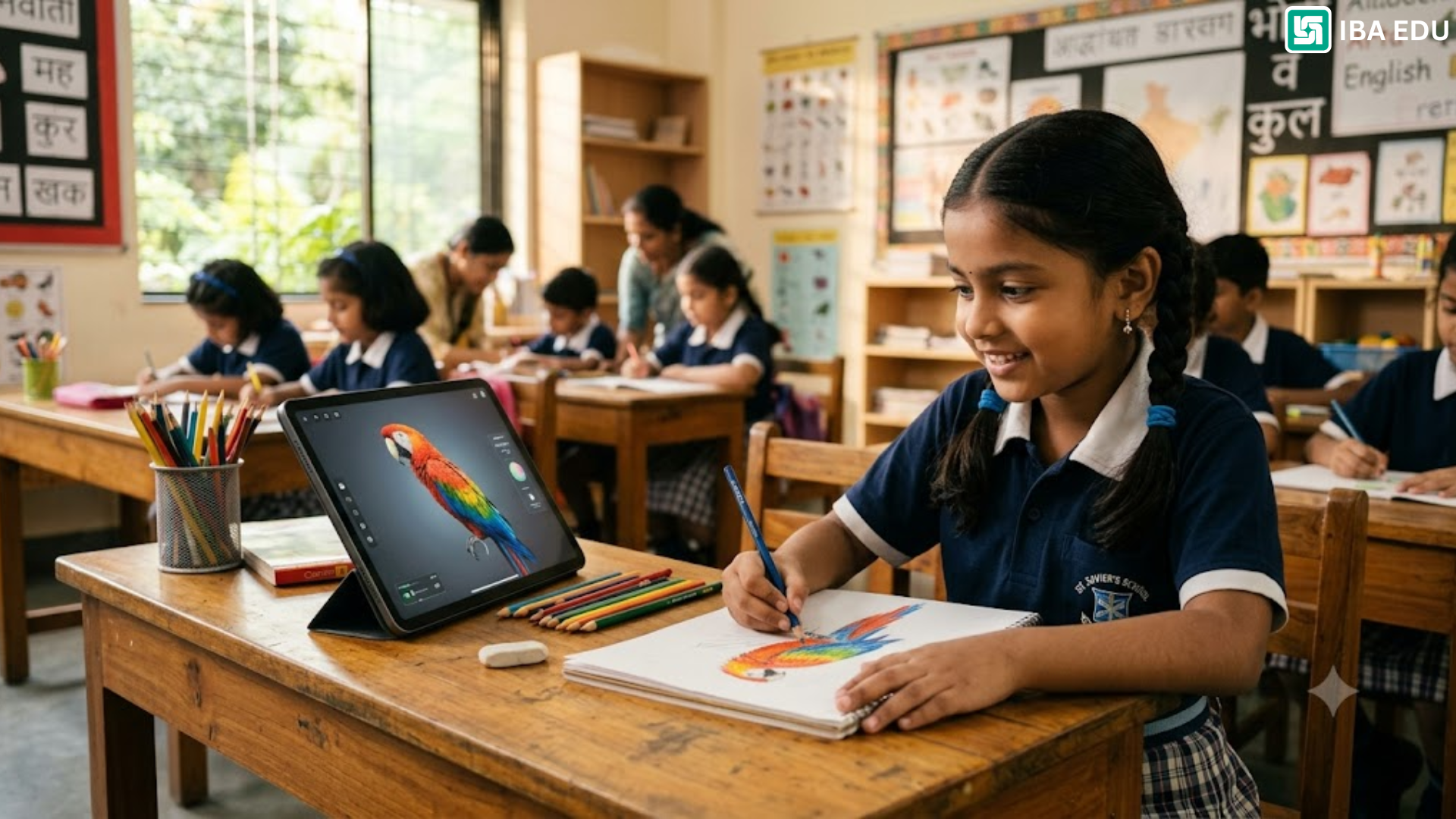
The Brain-First Process: Students read about the Amazon Rainforest. They close their books and use crayons to draw their own imaginary rainforest creatures, labeling the adaptations (e.g., “sticky toes for climbing”).
-
The AI Enhancement: Under teacher supervision, students upload their crayon drawings to an AI tool that transforms their sketches into vibrant, 3D-style digital art.
-
The Outcome: The class compiles these images into a digital “Encyclopedia of Imaginary Animals.” They have learned biology, exercised their imagination, and safely experienced AI as a magical tool that brings their ideas to life.
🧭 Middle School (Grades 5–8): Building Systems
-
The Scene: A 7th-grade mathematics and geography integration project.
-
The Brain-First Process: Students are tasked with understanding global trade routes. They calculate distances, costs, and travel times manually.
-
The AI Enhancement: They use AI data visualization tools to map out their calculated routes and use generative text models to simulate negotiations between different countries, based on prompts the students design using their geopolitical knowledge.
-
The Outcome: Students present a comprehensive trade strategy. They have practiced complex math, understood global economics, and learned how to use AI to model complex scenarios.
🎓 Secondary School (Grades 9–12): Innovating Solutions
-
The Scene: A high school physics class addressing renewable energy.
-
The Brain-First Process: Students research wind turbine mechanics. They debate the ethical and economic impacts of green energy grids in developing nations.
-
The AI Enhancement: Students use AI-assisted coding tools to build a basic simulation of a wind farm. They use advanced language models to pressure-test their economic arguments, acting as debate sparring partners.
-
The Outcome: Students present a fully realized, mathematically sound, and ethically considered proposal for a local micro-grid. They graduate not as passive test-takers, but as articulate, confident problem-solvers ready for the modern workforce.
12. The Long-Term Benefits of the Ecosystem
Adopting the IBA EDU AIFC Program creates a ripple effect of positive outcomes across the entire school community.
| Stakeholder | Long-Term Benefits of Brain-First AI Learning |
| Students | Develop robust critical thinking; build impressive digital portfolios; cultivate ethical AI habits; build unshakable creative confidence; prepare for future careers that don’t yet exist. |
| Teachers | Transition into highly respected mentors and facilitators; experience renewed passion for teaching; utilize AI to reduce administrative burnout and focus on student engagement. |
| Parents | Gain peace of mind knowing screen time is being converted into “smart time”; see tangible, creative outputs (books, games, apps) rather than just report cards; trust the school is future-proofing their child. |
| School Management | Establish the institution as a pioneer in education innovation; attract progressive parents; align seamlessly with modern global education mandates; improve overall academic engagement. |
13. Alignment with NEP 2020 Competencies
For educational institutions in India, the AI Future Creators Program is not just an innovative add-on; it is the perfect vehicle for realizing the vision of the National Education Policy (NEP) 2020.
NEP 2020 mandates a shift away from rote learning toward competency-based education, experiential learning, and the integration of emerging technologies to support learner-centric pedagogical practices. The policy specifically emphasizes the ethical and pedagogical use of AI to develop essential skills like critical thinking, digital literacy, and problem-solving.
The AIFC Brain-First model embodies these directives perfectly. By requiring students to Think, Understand, and Create before utilizing AI, schools seamlessly assess competencies rather than memory. When a student builds a history podcast or a science simulation, they are demonstrating their competency in a tangible, measurable, and highly engaging way. AIFC turns the aspirations of NEP 2020 into everyday classroom realities.
14. Why Schools Should Adopt a Brain-First AI Learning Ecosystem Today
The window to be a pioneer in AI education is closing rapidly. Within a few years, AI in the classroom will be a standard expectation, not a luxury.
Schools that adopt the “wait and see” approach risk falling behind, leaving their students vulnerable to prompt dependency and leaving their institutions viewed as antiquated. Conversely, schools that blindly adopt AI without a pedagogical framework will face a crisis of academic integrity and declining cognitive stamina among their students.
By adopting the IBA EDU Brain-First AI Learning Ecosystem today, school leaders take decisive control of the narrative. You send a powerful message to your community: We are embracing the future, but we are doing it on our terms. We are protecting the human mind while equipping it with the tools of tomorrow.
This is your opportunity to elevate your school’s brand, empower your educators, and profoundly alter the life trajectories of your students.
15. The Vision: Raising the Architects of the Future
If we give a child a robotic arm, we must first ensure their own muscles are strong enough to carry the weight. If we give a child an artificial brain, we must first ensure their own mind is resilient, imaginative, and morally grounded.
The ultimate vision of the AI Future Creators Program is not to produce students who know how to use AI. The vision is to produce thinkers, creators, innovators, and empathetic leaders who use AI to build a better world. We want students who look at a blank screen not with anxiety, waiting for the machine to tell them what to do, but with fierce creative joy, knowing exactly how to command the machine to serve their vision.
Thinking must always come first. The brain must lead the algorithm.
Transform Your School Today
The future of education is not about competing with machines; it is about elevating humanity. Equip your students to become the innovators of tomorrow with the AI Future Creators (AIFC) Program.
Is your school ready to move beyond rote learning and step into the future of creative intelligence? Partner with IBA EDU today to implement the Brain-First AI Learning Ecosystem and position your institution at the forefront of global education innovation.
