

Currently Empty: ₹0.00



Blog
Beyond Academic Results: What Truly Defines an Excellent School in the 21st Century?
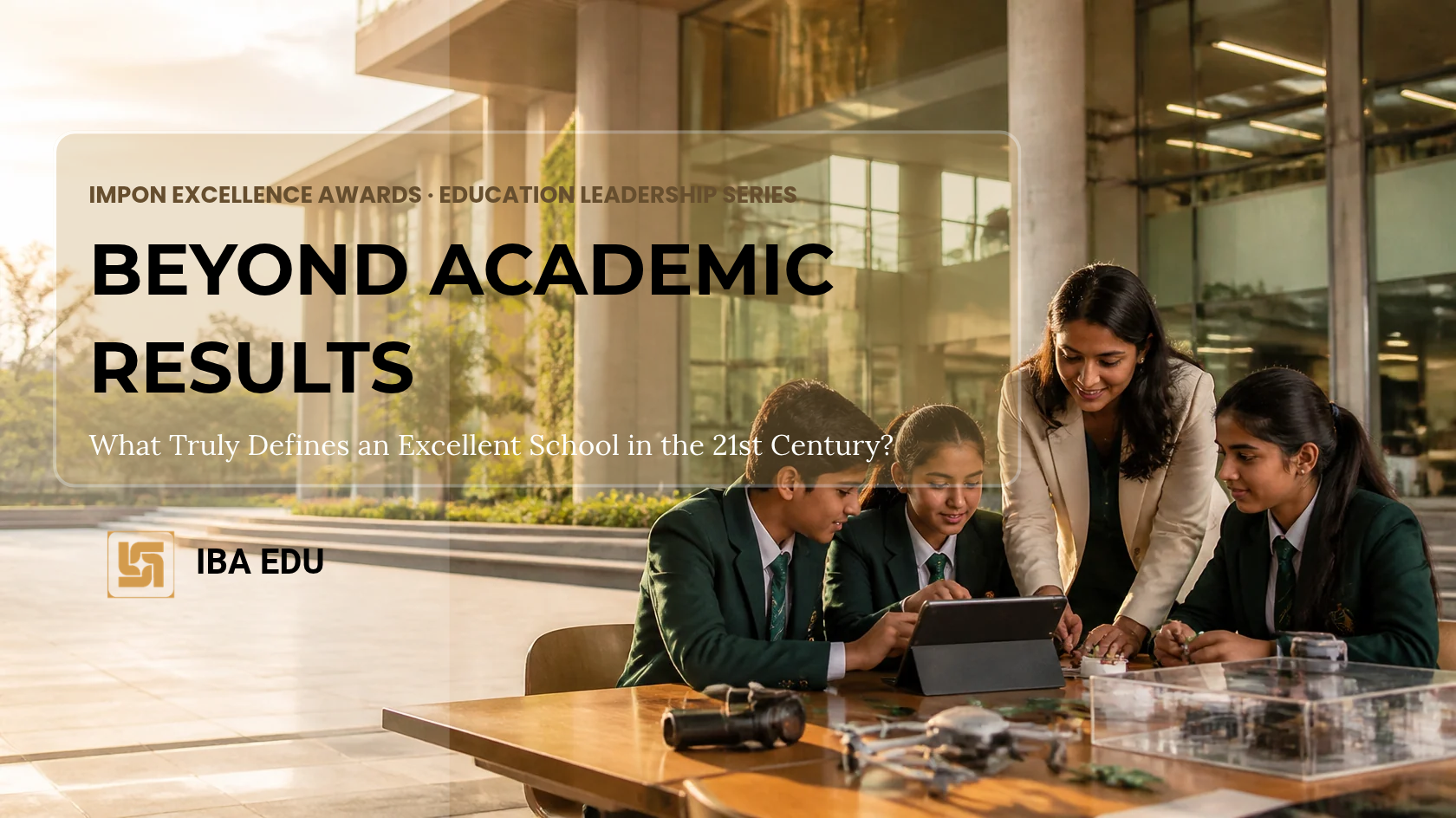
Beyond Academic Results: What Truly Defines an Excellent School in the 21st Century?
An exploration of the leadership, learning culture, teaching practices and institutional values that distinguish schools committed to shaping the future.
Imagine two schools.
Both consistently achieve excellent board examination results. Both have qualified teachers, well-maintained campuses and a strong academic reputation.
But look beyond their report cards.
In the first school, students are encouraged to question, experiment, collaborate and develop their own ideas. Teachers are supported in exploring new teaching approaches. The leadership team invests in professional development, student well-being and meaningful learning experiences.
In the second, success is primarily measured through examination scores, rankings and the number of students securing top marks.
Both schools may be academically successful. But are they equally prepared to shape the next generation?
This question deserves serious attention from every school owner, correspondent, principal and educator.
Because the world students are growing into is changing faster than the traditional measures of educational success can capture.
Academic achievement tells us what students have learned. The wider school experience tells us how they are learning, who they are becoming and how prepared they may be for what comes next.
It is time to look beyond examination results and examine what truly makes a school excellent.
1. The Definition of School Excellence Is Changing
For generations, academic performance has been one of the most visible measures of a school’s reputation.
Board examination results, pass percentages, subject toppers and competitive examination selections have helped parents evaluate schools and institutions communicate their achievements.
These indicators matter. Academic rigour, foundational knowledge and subject mastery will always remain essential responsibilities of a good school.
However, they represent only one part of a much larger educational picture.
The National Education Policy (NEP) 2020 recognises this broader responsibility. It emphasises holistic development, critical thinking, experiential learning, creativity, problem-solving and the development of well-rounded individuals.
It also calls for moving beyond rote learning towards deeper understanding and competency-based education.
This represents an important shift in how educational success should be understood.
A school cannot claim to be future-ready simply because its students perform well in examinations. It must also create opportunities for students to apply knowledge, explore interests, develop capabilities and understand the world around them.
The question for school leaders is no longer simply:
How well are our students performing?
It is also:
How effectively are we preparing them for life beyond school?
2. Eight Dimensions That Shape an Excellent School
Educational excellence is not created through a single achievement or department. It develops through the combined efforts of leadership, educators, students, infrastructure, institutional culture and the wider community.
Here are eight dimensions that deserve greater attention when understanding the quality of an educational institution.
01. Visionary Leadership and Institutional Culture
Behind every progressive school is leadership that understands where education is heading.
A principal or correspondent does more than manage daily operations. Effective school leadership establishes the institution’s vision, creates an environment for innovation, supports teachers and ensures that decisions remain focused on student development.
But leadership excellence is not measured by administrative efficiency alone.
It is reflected in the questions leaders ask:
- Are teachers encouraged to experiment with new pedagogical approaches?
- Does the school have a clear long-term development vision?
- Are decisions guided by student needs and educational outcomes?
- Is there a culture of accountability, collaboration and continuous improvement?
- Does the leadership team actively listen to educators, parents and students?
An excellent school is not necessarily the one with the most impressive vision statement. It is the one that translates its vision into everyday practices.
02. Teaching Quality and the Power of Great Educators
Buildings, laboratories and technology can support education, but teachers bring learning to life.
A great teacher does more than deliver lessons. They identify different learning needs, encourage curiosity, explain complex ideas, inspire confidence and help students discover their abilities.
As classrooms become more diverse and educational expectations evolve, teaching must also evolve.
Schools should increasingly invest in:
- Continuous teacher professional development.
- Innovative and student-centred teaching methods.
- Collaborative learning among educators.
- Technology-enabled teaching practices.
- Mentoring and knowledge-sharing opportunities.
- Recognition of outstanding teaching contributions.
The OECD’s work on teacher professional learning highlights the importance of continuous development throughout a teacher’s career.
For school managements, this creates an important leadership responsibility: teacher development should be treated as an institutional priority, not merely an occasional training activity.
The quality of a school’s educational experience is closely connected to the quality of support its teachers receive.
03. Future-Ready Learning Beyond the Classroom
The world students will enter as adults will demand more than the ability to reproduce information.
They will need to analyse situations, solve unfamiliar problems, communicate effectively, work with others and adapt to changing circumstances.
These capabilities are developed through learning experiences that connect knowledge with application.
Consider a science lesson.
Students can memorise the principles of environmental conservation and reproduce them in an examination. Alternatively, they can investigate a local environmental problem, conduct observations, collaborate on solutions and present their findings.
Both involve learning. But the second creates opportunities to apply knowledge in a meaningful context.
Schools can encourage future-ready learning through:
- Project-based learning.
- Research and inquiry activities.
- Interdisciplinary projects.
- Design thinking and creative problem-solving.
- Communication and presentation opportunities.
- Practical exposure to real-world challenges.
The objective is not to replace academic learning. It is to make academic learning more meaningful.
04. Technology, Digital Literacy and AI Awareness
Technology is changing how people access information, communicate, create and work.
Artificial intelligence has added another dimension to this transformation.
For schools, the challenge is not simply to introduce more devices or digital platforms. It is to help students understand technology, use it responsibly and develop the judgement to distinguish useful information from unreliable content.
Digital readiness should include more than computer literacy.
It should encourage students to understand digital citizenship, information evaluation, online safety, responsible AI usage, creativity and problem-solving.
Schools also need to consider how technology can support teachers and improve learning experiences without replacing the human relationships at the heart of education.
A future-ready institution should ask:
- Are students learning how to use technology responsibly?
- Are teachers equipped to integrate relevant digital tools?
- Are students developing AI awareness and critical thinking?
- Is technology improving access, participation and learning?
- Are digital safety and responsible usage part of the school’s culture?
Technology should serve education, not become a substitute for meaningful teaching.
05. Student Well-being, Values and Character Development
A student’s development cannot be understood through academic performance alone.
Confidence, empathy, resilience, emotional awareness, integrity and respect for others influence how young people approach challenges and relationships.
Schools play a significant role in developing these qualities.
A positive learning environment should encourage students to express themselves, ask questions, make mistakes, learn from experiences and feel supported.
Equally important are safe spaces, inclusion, anti-bullying practices, physical activity, emotional support and opportunities for meaningful participation.
The quality of a school is reflected not only in how it celebrates its highest achievers, but also in how it supports students who need additional guidance.
An institution that values every learner creates a stronger foundation for holistic development.
06. Infrastructure That Enables Meaningful Learning
Infrastructure remains an important dimension of school quality.
However, the value of infrastructure should not be judged only by the size of a campus or the appearance of its buildings.
What matters is how effectively the learning environment supports educational objectives.
A well-equipped laboratory should encourage experimentation. A library should inspire reading and independent exploration. Sports facilities should encourage physical development and teamwork. Digital learning spaces should enable access to meaningful educational resources.
Schools should consider:
- Functional classrooms and learning spaces.
- Libraries and reading facilities.
- Science and computer laboratories.
- Sports and physical education facilities.
- Accessibility and inclusive infrastructure.
- Safety, hygiene and maintenance.
- Technology-enabled learning environments.
Infrastructure becomes an indicator of excellence when it translates into better opportunities for learning and development.
07. Student Opportunities, Creativity and Leadership
An excellent school creates opportunities for students to discover what they are capable of doing.
Not every student will become a topper, scientist, athlete or artist. But every student deserves opportunities to explore interests, develop talents and experience achievement.
Competitions, clubs, exhibitions, debates, sports, cultural programmes, entrepreneurship activities and innovation projects can help students develop confidence and a sense of responsibility.
These experiences also help educators recognise strengths that may not always be visible through conventional examinations.
The important question is whether opportunities are available to a broad range of students, rather than being limited to a small group of high performers.
A school that creates space for diverse talents creates a richer educational experience.
08. Community Engagement and Social Responsibility
Schools are not isolated institutions. They are important contributors to their communities.
Their influence extends through students, families, teachers, alumni and the values they promote.
Community projects, environmental initiatives, parent engagement, volunteering and social responsibility activities help students understand that education carries responsibilities beyond personal success.
For school leaders, community engagement also offers opportunities to build stronger relationships with parents and local stakeholders.
An institution’s contribution to society is an important part of its educational identity.
3. The Challenge: Are We Measuring What Truly Matters?
Understanding these dimensions is one challenge. Evaluating them consistently is another.
Many schools already undertake valuable initiatives across teaching, student development, infrastructure and community engagement.
However, these contributions may not always be documented, reviewed or communicated through a structured institutional perspective.
A school may have exceptional teachers but lack a systematic approach to documenting professional development.
Another may offer outstanding student innovation opportunities but may not have a clear process for reviewing their impact.
A third may have invested significantly in infrastructure without assessing how effectively those facilities support learning.
This creates an important opportunity for school managements.
Instead of looking at institutional success through isolated achievements, schools can benefit from examining the complete educational ecosystem.
A useful institutional review should encourage leaders to consider five questions:
- What are we doing well? Identify the practices and capabilities that contribute to institutional strength.
- What evidence supports our achievements? Look beyond claims and examine documented practices, outcomes and initiatives.
- Where are the gaps? Identify areas where institutional processes or opportunities can improve.
- Are our efforts reaching students? Understand whether institutional investments translate into meaningful student experiences.
- What should we improve next? Convert reflection into realistic priorities and measurable action.
The purpose of evaluation should not be to create another administrative exercise.
It should be to help schools understand themselves better.
4. Recognition Should Encourage Reflection, Not Just Competition
Recognition has an important place in education.
It acknowledges effort, celebrates achievements and brings visibility to institutions and individuals who contribute meaningfully to the sector.
But recognition becomes more valuable when it encourages institutions to reflect on their practices and identify opportunities for progress.
A trophy may represent an achievement at a particular moment. A meaningful institutional evaluation can encourage a school to think about what it should continue, strengthen or change.
This distinction matters.
Schools should seek recognition that values credible assessment, relevant evidence and a broader understanding of educational contribution.
Similarly, recognition programmes should communicate their criteria, eligibility requirements and evaluation processes clearly.
When recognition and reflection work together, awards can become part of a larger culture of institutional development.
5. A New Conversation About School Excellence
At Impon, we believe that the conversation about school excellence needs to become broader, more meaningful and more inclusive of the different contributions that shape education.
The objective should not be to diminish academic achievement or compare institutions through a single measure.
It should be to encourage a more complete understanding of what makes an educational institution valuable.
This means recognising the importance of leadership, teaching quality, institutional culture, student development, innovation, infrastructure and social contribution.
It also means encouraging schools to document their initiatives, understand their strengths and approach institutional development with greater clarity.
School excellence is not a destination that an institution reaches once. It is a commitment that must be demonstrated through everyday decisions, practices and progress.
As part of this larger conversation, the Impon Excellence Awards initiative seeks to bring greater attention to the multiple dimensions of institutional excellence and celebrate schools contributing to the future of education.
We believe that the schools shaping tomorrow deserve to be recognised for more than the results they publish today.
6. Five Questions Every School Leader Should Reflect On
Before evaluating how successful an institution has become, its leadership team could consider the following:
1. Beyond academic results, what makes our school distinctive?
Can the institution clearly communicate its educational philosophy, teaching practices and student development initiatives?
2. Are our teachers continuously growing?
Does the school create meaningful opportunities for professional development, collaboration and innovation?
3. Are our students developing capabilities for the future?
Do they have opportunities to apply knowledge, solve problems, collaborate, communicate and explore new ideas?
4. Are we creating an environment where every student can thrive?
Are safety, inclusion, well-being and individual development embedded in everyday school practices?
5. Do we regularly evaluate our institutional progress?
Are our achievements documented, our gaps understood and our improvement priorities clearly defined?
The answers may reveal that a school is doing more than it realises. They may also uncover opportunities that deserve greater attention.
Either way, reflection is a valuable starting point.
The Bigger Question Is Not How We Rank. It Is How We Grow.
The future of education will not be shaped by examination results alone.
It will be shaped by institutions that combine academic rigour with curiosity, knowledge with application, technology with responsibility, and achievement with values.
It will be shaped by leaders who empower teachers, educators who inspire learners and schools that recognise every student’s potential.
The challenge for today’s school leaders is to build institutions that are not only successful by conventional measures, but also meaningful in the lives they influence.
At Impon, we believe this broader understanding of excellence deserves greater attention, dialogue and recognition.
Because the true measure of a great school is not just what its students achieve while they are there.
It is also what they carry with them when they leave.
Impon Excellence Awards | Recognising Excellence. Celebrating Impact. Inspiring the Future of Education.
Register My School | Talk to our Team
