
Currently Empty: ₹0.00



Blog
The Next Revolution Has Already Begun: Are We Preparing Our Children for the Future?
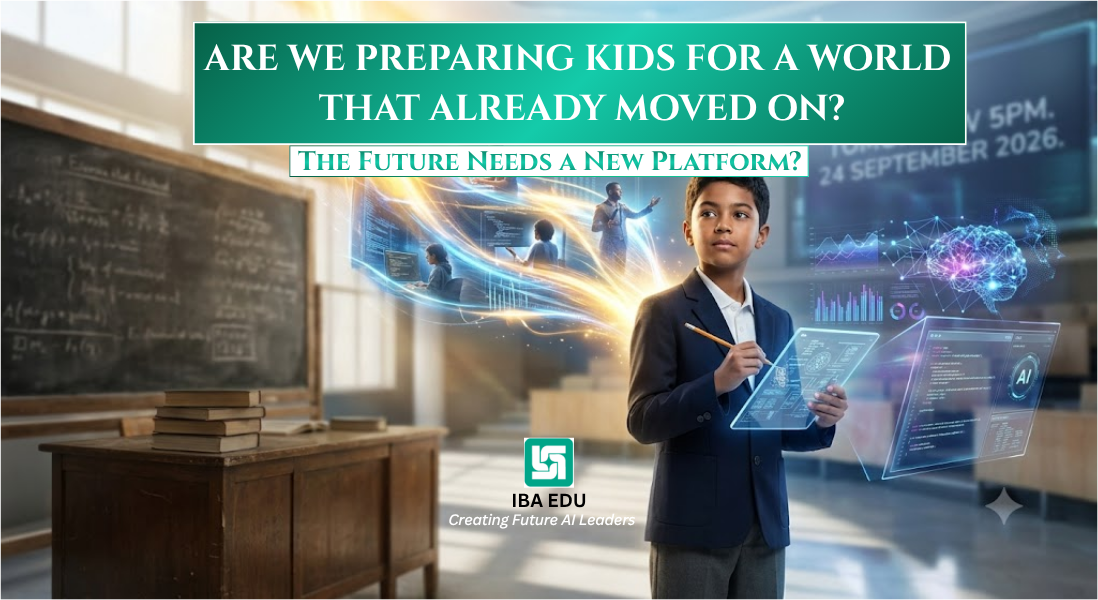
The Next Revolution Has Already Begun. Are We Preparing Our Children for It?
Pre-Launch Awareness Blog | IBA EDU | September 23, 2026
Something significant is about to be revealed on September 24, 2026, at 5:00 PM. But before we reveal what it is, we want every parent, teacher, school leader, and student to pause and ask one important question:
Are we preparing our children for the world they are going to live in, or only for the world we already know?
Throughout history, technology has changed the way people live, work, learn, and build their futures. Every major technological revolution has created new opportunities. Yet, not everyone recognized those opportunities at the same time.
Some embraced change early. Some waited. Others resisted until the change became unavoidable.
And today, we are standing at the beginning of another transformation.
The AI Revolution.
But this time, the question is not simply who will use the technology.
The question is: Who will learn to create, innovate, and build with it?
1. Every Revolution Creates Opportunities. But Who Recognizes Them First?
Think about the major technological transformations that have shaped modern society.
The Electricity Revolution: From a New Technology to Everyday Life
When electricity began transforming industries and homes, it opened the door to entirely new ways of working, manufacturing, communicating, and living.
Businesses that embraced electrical power and developed new applications gained opportunities to grow. Over time, electricity became part of everyday life.
Those who adopted it later could still benefit from its convenience, but the earliest opportunities to build new businesses and industries had already begun to evolve.
The lesson?
When a new technology emerges, there is a difference between simply consuming it and understanding how to use it to create opportunities.
The Computer Revolution: Learning a New Way of Working
As computers entered offices, industries, and educational institutions, they changed how people managed information, designed products, performed calculations, and carried out professional work.
People who learned computer skills early gained access to emerging roles and new ways of doing business. Organizations that adopted computerization transformed their operations.
Those who delayed learning eventually had to catch up with changing workplace expectations.
Computers did not eliminate the need for learning. They changed what people needed to learn and how they needed to work.
The lesson is not that everyone who adopted computers became a technology giant or that everyone who delayed became unsuccessful.
The lesson is that early exposure, practical learning, and the willingness to adapt can influence the opportunities available to individuals and organizations.
The Internet Revolution: From Connection to Creation
The internet changed the way the world communicated, traded, learned, and built businesses.
It created opportunities in e-commerce, digital services, telecommunications, online education, media, and countless other industries.
Some entrepreneurs recognized its potential and built businesses around it. Others initially used the internet primarily as consumers, gradually learning how to participate in the digital economy.
Today, internet access is a normal part of everyday life for billions of people.
But the people who understand how digital platforms work, how online businesses are built, and how technology can solve problems have access to a different set of possibilities.
Every revolution brings a choice: remain only a user, or explore the possibility of becoming a creator.
2. Now, the AI Revolution Is Changing the Question
Today, Artificial Intelligence is transforming how people write, design, research, communicate, analyze information, and solve problems.
Businesses are exploring AI-powered workflows. Professionals are learning new tools. Entire industries are examining how their work may change.
Some people are learning AI out of curiosity.
Some are learning it because their careers demand it.
Some are building products and businesses with it.
And some are still asking:
“Is AI really necessary for me?”
For many years, technology skills were often treated as an additional advantage. Today, AI literacy and the ability to work alongside evolving technology are becoming increasingly relevant to how people prepare for the future.
However, AI is not a guarantee of success, and no one can predict exactly which occupations will disappear, change, or emerge.
What we can recognize is this:
The ability to learn, adapt, think critically, and use technology meaningfully is becoming increasingly important.
And that brings us to a much bigger question.
If the world of work is changing, should the way we prepare our children remain the same?
3. A Question for Every Parent: What Are We Preparing Our Children For?
Let’s consider the learning journey of a school student.
A child learns Microsoft Word.
A child learns PowerPoint.
A child learns Excel.
A child may learn programming languages such as Python.
These skills can still be useful. Digital productivity, communication, data literacy, and coding can all contribute to a strong foundation.
But learning a tool is not the same as learning how to think, solve problems, create something meaningful, and adapt when the tools change.
Imagine a student who can create a presentation.
Now imagine a student who can:
-
Identify a real-world problem.
-
Research and understand the subject.
-
Develop an original idea.
-
Use AI tools responsibly to explore solutions.
-
Create a visual explanation or digital project.
-
Present the work to an audience.
-
Receive feedback and improve the outcome.
Which learning experience gives the student more opportunities to demonstrate understanding?
This is not about removing foundational subjects or replacing every existing learning method.
It is about expanding education beyond the completion of a syllabus.
Because the future will need children who can do more than remember information.
It will need children who can think, create, communicate, collaborate, and continue learning.
4. The World Has Changed. Has the Learning Experience Changed Enough?
Over the last several decades, India has experienced significant changes in technology, infrastructure, business, income, and economic development.
Our children have access to resources that previous generations could not easily imagine.
They can explore information from around the world.
They can connect with people across borders.
They can learn through digital platforms.
They can experiment with creative tools.
They can discover ideas beyond the boundaries of a classroom.
Yet one question deserves our attention:
Are we changing only what children learn, or are we also changing how they learn and demonstrate what they know?
Syllabuses evolve.
Subjects are updated.
New technologies are introduced.
But meaningful educational transformation also requires us to examine teaching approaches, practical learning, creativity, problem-solving, and opportunities for students to demonstrate their abilities.
A child should not be defined only by how well they reproduce an answer in an examination.
Examinations have a role in education. They can assess knowledge and understanding.
But they are not the only way to recognize a student’s potential.
Learning deserves a space where it can be explored, applied, demonstrated, and shared.
And this leads to a question we believe deserves a national conversation.
5. Where Is the Stage for Students to Showcase What They Have Learned?
Think about the different ways people demonstrate their skills.
A Student Who Learns Cricket
They practice.
They improve their technique.
They participate in matches.
They experience teamwork and competition.
They get opportunities to demonstrate their skills on the field.
A Student Who Learns Dance
They practice movements.
They develop coordination and expression.
They perform on a stage.
They receive feedback and recognition.
A Student Who Learns Taekwondo
They train consistently.
They develop discipline and technique.
They participate in demonstrations or competitions.
They showcase their abilities in front of an audience.
Now consider a student who spends months learning science, mathematics, social science, digital tools, or creative skills.
Where does that student get the opportunity to demonstrate what they have understood and created?
In many cases, students showcase their learning through assignments, projects, classroom presentations, exhibitions, and examinations.
These experiences are valuable. But opportunities vary significantly between schools, and not every student gets access to a public platform that recognizes their creativity and practical application of knowledge.
A student may have a brilliant idea.
A student may have a unique way of explaining a difficult concept.
A student may be able to transform a school subject into a creative digital project.
A student may have the potential to inspire others.
But without an opportunity to showcase that work, their abilities may remain unseen beyond the classroom.
Learning should not end with a mark. It should create opportunities for expression.
The question is not whether marks matter.
The question is whether we are giving students enough ways to demonstrate the skills behind those marks.
6. From Learning to Demonstration: What If School Subjects Became Creative Opportunities?
Imagine a student learning a chapter in science.
Instead of only reading the lesson and answering questions, the student explores how to explain the concept through a visual poster, an animated video, or a digital story.
Imagine a student studying mathematics.
The student develops a creative way to communicate a mathematical idea to another student.
Imagine a student learning social science.
The student explores a topic, organizes information, and creates an engaging explanation for an audience.
In each example, the student is not simply using a tool.
The student is engaging with a subject, making decisions, communicating ideas, and applying knowledge.
AI can support some of these activities when used thoughtfully. But the technology should not replace the student’s thinking, effort, or understanding.
The goal is not to teach children to depend on AI for every answer. The goal is to help them develop the confidence and skills to use emerging technology responsibly while thinking for themselves.
This is where education can open new possibilities.
Not by asking children to compete with machines.
But by helping children develop the human abilities that matter as technology evolves.
7. A New Responsibility for Parents, Teachers, and Schools
Preparing children for the future is not the responsibility of one group alone.
For Parents
Parents want their children to be confident, capable, and prepared for opportunities that lie ahead.
Beyond academic performance, children need opportunities to explore interests, develop creativity, practice problem-solving, and experience constructive feedback.
A useful question to ask is:
“What opportunities does my child have to demonstrate what they can create and what they understand?”
For Teachers
Teachers play an important role in helping students connect knowledge with practical application.
A classroom can become a place where children ask questions, explore ideas, experiment, and communicate what they have learned.
Technology can support teachers in creating these experiences, while the teacher’s guidance remains essential.
For Schools
Schools have the opportunity to build learning environments that recognize both academic development and practical abilities.
Students can benefit from exhibitions, challenges, collaborative projects, and other opportunities that allow them to share their work with a wider audience.
A school is not only a place where knowledge is delivered.
It can also be a place where young people discover what they are capable of creating.
8. The Future Belongs to Those Who Keep Learning
Let’s return to the technological revolutions we discussed.
Electricity changed industries.
Computers changed workplaces.
The internet changed connectivity and business.
Artificial Intelligence is changing how people interact with technology and how work is performed.
Each transformation created new possibilities, but it also required people to learn and adapt.
We should not tell children that one technology will guarantee their future success.
We should not frighten them into believing that every existing career will disappear.
Instead, we should help them develop the mindset to approach change with curiosity, responsibility, and confidence.
Because the future is not built only by people who know how to use today’s tools.
It is also shaped by people who can identify problems, ask meaningful questions, learn new skills, and create solutions.
Our children deserve the opportunity to become active participants in that future.
Not just consumers of technology.
Not just followers of trends.
But thinkers, creators, innovators, and responsible digital citizens.
9. At IBA EDU, We Asked Ourselves a Different Question
At IBA EDU, we have been exploring an important question:
What if students had a platform where they could demonstrate their learning, showcase their creativity, and take their ideas beyond the classroom?
What if a school student’s work could be seen by an audience beyond their classroom?
What if children could learn through practical challenges and experience the process of creating something of their own?
What if parents could witness not just what their children have memorized, but what they can imagine, develop, and communicate?
What if schools could create more opportunities for students to apply their knowledge in meaningful ways?
These questions have shaped our thinking about the future of learning.
We believe that children need more opportunities to explore, create, and demonstrate their abilities.
We believe that schools can play a meaningful role in connecting learning with real-world experiences.
And we believe that responsible exposure to emerging technologies should begin with curiosity, age-appropriate learning, and strong human guidance.
The future of education is not only about what children learn. It is also about what they get the opportunity to do with what they learn.
10. Something Big Is Coming Tomorrow
For the past several months, we have been thinking about the changing world of technology, the future of education, and the opportunities our children deserve.
We have asked questions.
We have explored possibilities.
We have considered what students, parents, teachers, and schools need in a rapidly changing world.
And now, we are preparing to reveal something we have been working towards.
Something designed around a simple but important belief:
Every child deserves opportunities to learn, create, and showcase their potential.
We are not revealing the details today.
We want you to pause, reflect, and ask yourself:
-
Is my child ready to explore the changing world of technology?
-
Does my child have enough opportunities to showcase their creativity?
-
How can schools create more practical learning experiences?
-
What would it mean if students could take their learning to a wider audience?
-
Are we preparing children only to answer questions, or also to create meaningful solutions?
Tomorrow, we will begin answering these questions.
COMING TOMORROW
September 24, 2026
5:00 PM IST
A New Opportunity for Young Minds
Something meaningful is on its way for students, parents, and schools.
Stay curious. Stay connected. Be ready.
A Message to Parents and Schools
The next generation will grow up in a world where technology continues to evolve.
Let’s give them more than access to technology.
Let’s give them opportunities to think.
Let’s give them opportunities to create.
Let’s give them opportunities to demonstrate what they have learned.
Let’s give them opportunities to be seen.
The future is changing. The question is, how are we preparing our children for it?
Something big is coming.
24 September 2026 | 5:00 PM
Stay tuned to IBA EDU.
