Currently Empty: ₹0.00



Blog
How AI Future Skills Can Strengthen Your School’s Brand and Admissions

Parents are asking different questions now. Is your school ready to answer them?
A few years ago, parents choosing a school typically asked:
What board does the school follow?
How strong are the academic results?
What extracurricular activities are available?
What facilities does the school offer?
Today, those questions still matter. But a new set of questions is beginning to emerge.
How is your school preparing my child for a future shaped by Artificial Intelligence?
Will my child learn how to use AI responsibly—not just use it for answers?
What future skills will students develop beyond the traditional curriculum?
How is your school meaningfully different from other schools in the city?
These are no longer questions about technology alone.
They are questions about readiness, relevance, opportunity, trust, and the future of the child.
For school leaders, this creates a significant opportunity.
Schools that introduce meaningful AI future-skills education can do more than expose students to new technology. They can create visible student outcomes, strengthen parent confidence, build a clearer institutional identity, and develop a more compelling story for admissions.
The question is no longer simply:
Should students learn about AI?
The more strategic question is:
How can schools prepare students for an AI-powered future while strengthening their educational value, parent confidence, school brand, and admissions appeal?
2026 School AI Readiness Checklist
Parents Are Asking Different Questions Now
The expectations placed on schools are evolving.
Parents will always value academic excellence, quality teachers, safety, discipline, infrastructure, sports, arts, and extracurricular activities.
Those fundamentals remain essential.
But today’s parents are also thinking about a world that is changing rapidly.
They see AI transforming how people work, create, research, communicate, solve problems, and make decisions.
Naturally, they are beginning to wonder:
Will my child be prepared for that world?
And increasingly, they may look to schools for the answer.
The Parent Conversation Is Evolving
A few years ago, parents asked:
- What board does your school follow?
- What are your academic results?
- What extracurricular activities do you offer?
- What facilities are available?
Today, forward-thinking parents are also asking:
- How are you preparing my child for an AI-powered future?
- Will students learn to use AI responsibly?
- What future skills will my child actually develop?
- Can students create with technology rather than simply consume it?
- How is your school preparing children for careers that may not even exist yet?
This represents an important shift.
AI readiness is no longer only a technology conversation. It is becoming a conversation about educational relevance, student capability, parent confidence, and school differentiation.

How AI-Ready Is Your School?
Before exploring how AI future skills can strengthen your school, consider five simple questions:
- Do your students currently learn how to use AI responsibly?
- Can your school show parents visible evidence of future-skills development?
- Does your admissions team have a clear answer when parents ask about AI readiness?
- Are students creating original projects using modern technology?
- Does your school have clear expectations around responsible AI use and academic integrity?
If your answer to several of these questions is “Not yet,” that does not mean your school is behind.
It may simply mean that now is the right time to begin the conversation.
FREE RESOURCE FOR SCHOOL LEADERS
The 2026 School AI Readiness Checklist: 25 Questions Every School Leader Should Ask
Assess your school’s readiness across leadership, student AI literacy, responsible AI use, teacher preparedness, parent communication, and admissions strategy.
The Question Is No Longer: Does Your School Have Technology?
For years, schools demonstrated technological advancement through:
- Computer laboratories.
- Smart classrooms.
- Interactive boards.
- Tablets.
- Digital learning platforms.
- Learning management systems.
These technologies continue to play an important role in education.
But the conversation is evolving.
Having technology is not the same as developing technological capability.
The more meaningful question today is:
What can your students actually create, solve, communicate, and achieve with technology?
A smart classroom can help deliver content.
A future-ready learning environment should also help students become thinkers, creators, communicators, problem-solvers, and responsible users of powerful technologies.
The next generation of school differentiation may therefore come not from having more devices—but from developing more capable students.
From Smart Classrooms to Smart Creators
The shift towards AI future-skills education is not about replacing traditional learning.
It is about expanding what students are capable of doing.
| Traditional Technology Approach | Future-Ready AI Learning |
|---|---|
| Students consume digital content | Students create original digital projects |
| Technology supports classroom lessons | Technology helps students explore and develop ideas |
| Focus on software familiarity | Focus on creativity, critical thinking and communication |
| Students learn what tools do | Students learn what they can achieve with tools |
| Generic “future-ready” claims | Visible student outcomes |
| Certificates show participation | Portfolios demonstrate capability |
| Technology is the focus | The student’s thinking and creativity are the focus |
The difference is fundamental.
The future-ready school is not defined by how much technology it owns. It is defined by what its students can do with technology thoughtfully, creatively, and responsibly.

What Are AI Future Skills for School Students?
AI future skills are not simply about teaching children how to type prompts into a chatbot.
A meaningful future-skills program should develop a broader combination of:
AI Literacy
Understanding what AI can and cannot do.
Critical Thinking
Questioning AI-generated information rather than accepting every output as fact.
Creativity
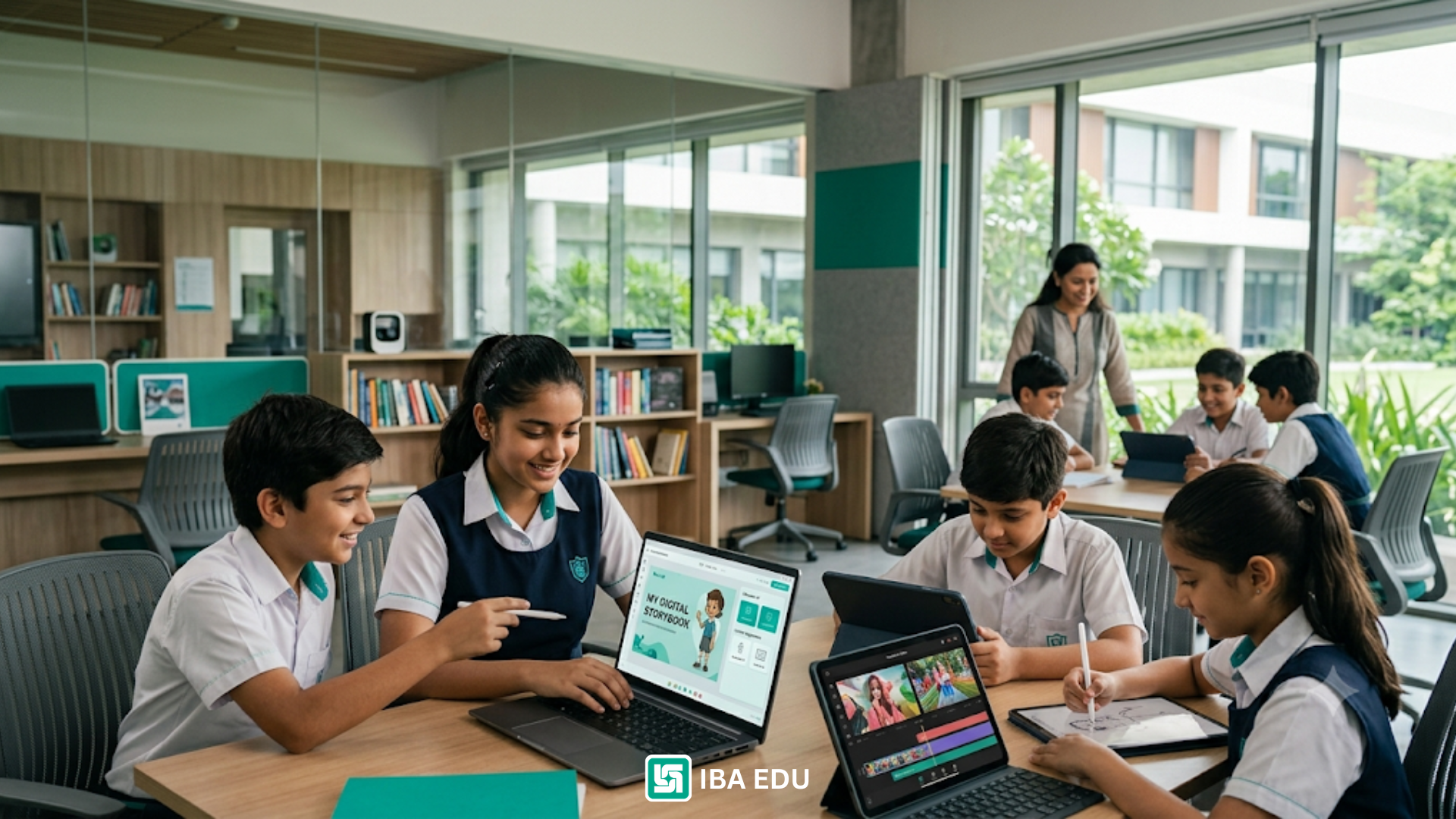
Turning original ideas into stories, visuals, videos, presentations, and digital experiences.
Communication
Learning to express ideas clearly and present work with confidence.
Responsible AI Use
Understanding privacy, verification, academic integrity, appropriate use, and human responsibility.
Project-Based Learning
Moving from passive lessons to tangible creative outcomes.
Depending on age and learning level, students may learn how to:
- Understand AI at an age-appropriate level.
- Ask better and more thoughtful questions.
- Use AI for brainstorming and idea development.
- Verify AI-generated information.
- Create digital stories and books.
- Design visual content and presentations.
- Produce creative videos.
- Build simple interactive digital experiences.
- Develop and present original projects.
- Create a personal portfolio of their work.
The goal should never be to produce children who depend on AI for every answer.
The goal should be to develop students who can:
Think independently. Ask better questions. Question AI outputs. Create original work. Make informed decisions. Use technology responsibly.
That distinction matters enormously to both educators and parents.
How AI Future Skills Can Strengthen Your School’s Brand
Every school has a brand.
It exists in what parents say about the school, how students describe their experience, what teachers communicate, what appears online, and what prospective families remember after an admissions interaction.
Some schools are known for academic excellence.
Others for sports.
Others for discipline, creativity, international exposure, innovation, or holistic development.
But there is a challenge.
Many schools use remarkably similar language:
Academic excellence.
Holistic education.
World-class infrastructure.
Future-ready students.
These are valuable promises. But when every institution makes similar claims, differentiation becomes increasingly difficult.
AI future-skills education gives schools an opportunity to make the idea of being future-ready visible and tangible.
Instead of merely saying:
“We prepare students for the future.”
A school can demonstrate it:
“Our students learn to use AI responsibly to develop ideas, create digital stories, build visual projects, produce videos, design interactive experiences, communicate their thinking, and develop portfolios of original work.”
The difference is powerful.
One is a promise.
The other is evidence.
A powerful school brand is built when promises become visible outcomes.
How AI Future Skills Can Create a Stronger Admissions Story
Imagine two schools speaking to the same prospective parent.
School A Says:
“We have excellent teachers, smart classrooms, extracurricular activities, modern infrastructure, and strong academic results.”
Now imagine another conversation.
School B Says:
“Alongside academic excellence, our students learn how to use AI responsibly to develop ideas, think critically, create original digital projects, communicate confidently, and build portfolios demonstrating what they can do.”
Which school creates the more memorable future-ready story?
The answer will vary by parent. But School B has created an additional point of meaningful differentiation.
This becomes particularly valuable in competitive school markets where parents compare several institutions offering similar:
- Academic curricula.
- Infrastructure.
- Smart classrooms.
- Sports facilities.
- Extracurricular activities.
- Transportation.
- Digital learning environments.
AI future skills can give the admissions team another powerful story to tell:
We are not preparing children only for their next examination. We are helping them develop capabilities for the world they will eventually enter.
This message can become part of:
- Admissions counselling.
- School tours.
- Parent orientations.
- Open houses.
- School brochures.
- Website content.
- Social media.
- Student exhibitions.
- Annual-day presentations.
AI education therefore becomes more than an academic initiative.
It can become part of the school’s admissions narrative.
A Question Every Admissions Team Should Be Ready to Answer
“How is your school preparing my child for an AI-powered future?”
What will your admissions team say?
Will the answer be:
“We have smart classrooms.”
Or:
“We teach computer science.”
Or can your school demonstrate a more compelling answer?
“Our students learn to think critically about AI, use it responsibly, transform ideas into original projects, communicate their work, and build visible portfolios demonstrating their progress.”
Parents don’t choose schools based on technology alone.
They choose based on what they believe the school can help their child become.
Is Your School Ready to Answer the Questions Modern Parents Are Asking?
You do not need to transform your entire school overnight.
You need a meaningful place to begin.
Not ready to discuss implementation yet?
[DOWNLOAD THE FREE SCHOOL AI READINESS CHECKLIST]
Exploring AI future-skills education for your students?
[SCHEDULE A SCHOOL DISCUSSION]
AI Future Skills Can Give Parents Visible Proof of Learning
The phrase “future-ready education” is used frequently.
But what does future readiness actually look like?
Parents need to see evidence.
A well-designed AI future-skills program can help students create tangible outcomes such as:
Digital Storybooks
Students transform ideas into structured visual narratives.
Creative Videos
Students learn to communicate ideas through modern visual storytelling.
Interactive Experiences
Students explore how ideas can become engaging digital experiences.
Visual Content
Students develop creativity, communication, and design thinking.
Presentations
Students learn to structure and confidently communicate their ideas.
Digital Portfolios
Students build collections of work demonstrating their progress and capabilities.
A parent may not fully understand technical terms such as generative AI, multimodal models, or prompt engineering.
But every parent can understand this:
“My child had an idea. They developed it. They created something original. They presented it. And they can explain how AI supported their creative process.”
That is where technology becomes meaningful.
Don’t showcase the AI tool. Showcase what the child can now do.
Your Students Can Become Your School’s Strongest Brand Ambassadors
The most convincing advertisement for a school may not be a brochure.
It may be a student confidently demonstrating what they have created.
Imagine students presenting:
- Their own digital storybooks.
- Original educational videos.
- AI-assisted visual stories.
- Interactive digital experiences.
- Creative awareness campaigns.
- Personal portfolios.
- Solutions to real-world challenges.
Now imagine showcasing those outcomes through:
- School exhibitions.
- Parent showcases.
- Website galleries.
- Social media.
- Admissions events.
- Annual-day presentations.
- Inter-school competitions.
- Student-led demonstrations.
Every meaningful student project becomes evidence of the school’s learning culture.
Instead of telling the world:
“We encourage creativity.”
Show students creating.
Instead of saying:
“We prepare students for the future.”
Show what students can actually do.
Instead of claiming:
“We embrace innovation.”
Let student outcomes prove it.
Student work can become authentic school storytelling.
AI Future Skills Can Create Powerful School Marketing Content
Schools continuously need meaningful stories for:
- Websites.
- Social media.
- Newsletters.
- Admissions campaigns.
- Parent communications.
- School events.
Student projects can create an authentic stream of compelling stories.
Imagine content such as:
“Meet the Grade 6 Students Who Created Their First Digital Storybooks.”
“From Imagination to Creation: Inside Our Student AI Project Showcase.”
“How Our Young Creators Turned Ideas Into Original Digital Experiences.”
“Inside Our AI Future Creators Showcase: Students Present Their Digital Portfolios.”
This is more credible than repeatedly publishing generic claims about innovation.
Why?
Because it contains the three elements parents value most:
The Student. The Learning Journey. The Outcome.
Future-Ready Does Not Mean AI-Dependent
This is one of the most important principles of responsible AI education.
A poorly designed approach can encourage students to ask AI for every answer.
A well-designed approach should do the opposite.
Students should learn:
- When AI use is appropriate.
- When they need to think independently.
- How to question AI-generated outputs.
- How to verify information.
- Why AI can make mistakes.
- Why human judgment remains essential.
- How to protect personal information.
- How to preserve originality.
- Why academic integrity matters.
A useful learning framework is:
THINK → ASK → QUESTION → VERIFY → CREATE → EXPLAIN
THINK: What am I trying to achieve?
ASK: Can I communicate my request clearly?
QUESTION: Does the AI-generated response make sense?
VERIFY: Is the information accurate and appropriate?
CREATE: How can I use my own judgment and creativity to produce something meaningful?
EXPLAIN: Can I describe what I created, why I made my choices, and how AI supported the process?
The goal is not to produce students who depend on AI.
The goal is to develop students who can use AI intelligently, critically, creatively, and responsibly.
Responsible AI Education Can Become a Trust Differentiator
Many parents are excited about AI.
Many are also concerned.
They may worry about:
- Overdependence on technology.
- Students copying AI-generated answers.
- Reduced independent thinking.
- Inappropriate content.
- Privacy and online safety.
- Excessive screen time.
- Academic integrity.
- The impact of AI on future careers.
Ignoring these concerns does not make them disappear.
Schools have an opportunity to lead the conversation.
A responsible school can say:
“We don’t simply give students access to AI. We teach them how to question it, verify it, use it appropriately, protect their privacy, preserve their originality, and understand when human thinking must come first.”
That is a far more powerful message than:
“Our school uses the latest AI tools.”
One communicates trend adoption.
The other communicates educational leadership.
Do Schools Need Expensive AI Labs or a Complete Curriculum Redesign?
Not necessarily.
One of the biggest concerns among school leaders is understandable:
“Do we need AI experts, new laboratories, expensive software, or a complete curriculum redesign?”
In many cases, schools can begin with a focused approach.
START SMALL → PILOT → CREATE → SHOWCASE → MEASURE → SCALE
Start Small
Choose an appropriate student group or grade level.
Pilot
Introduce a structured program with clearly defined outcomes.
Create
Help students develop tangible projects.
Showcase
Give students opportunities to present their work to parents and the school community.
Measure
Collect feedback from students, parents, teachers, and administrators.
Scale
Expand based on evidence, outcomes, and the school’s strategic priorities.
The goal is not to transform the entire school overnight.
The goal is to begin building meaningful future readiness today.
From AI Users to AI Creators
Children are already surrounded by technology.
They watch videos.
They play games.
They use apps.
They search for information.
They interact with digital platforms.
The opportunity for schools is to help them move from passive consumption towards purposeful creation.
Imagine a student confidently saying:
“I created this story.”
“I designed this project.”
“I made this video.”
“I built this digital experience.”
“I used AI to explore my idea—but I made the decisions.”
That is a fundamentally different relationship with technology.
The strongest AI learning experiences should not make the child disappear behind the tool.
They should make the child’s imagination, thinking, voice, and creativity more visible.
Is Your School Ready for AI Future Skills?
Answer these five questions:
1. Do students currently learn responsible AI use?
Yes / Not Yet / Unsure
2. Can your school demonstrate visible future-skills outcomes to parents?
Yes / Not Yet / Unsure
3. Does your admissions team have a strong answer when parents ask about AI readiness?
Yes / Not Yet / Unsure
4. Do students create original digital projects using modern AI tools?
Yes / Not Yet / Unsure
5. Does your school have clear guidance around responsible AI use and academic integrity?
Yes / Not Yet / Unsure
If you answered “Not Yet” or “Unsure” to two or more questions, this may be the right time to begin a structured AI-readiness conversation.
[GET THE COMPLETE 25-POINT SCHOOL AI READINESS CHECKLIST]
What Should Schools Look for in an AI Future-Skills Program?
Before implementing an AI learning program, school leaders should ask:
- Is the content appropriate for the students’ age?
- Does the program teach responsible and ethical AI use?
- Are students actively creating, or simply watching demonstrations?
- Does the curriculum encourage independent thinking?
- Are there tangible projects and visible learning outcomes?
- Can parents see evidence of what their children have learned?
- Does the program complement the school’s existing curriculum?
- Is implementation practical for teachers and administrators?
- Can students showcase and explain their work?
- Does the program support the school’s broader educational vision?
The best AI program is not necessarily the one that teaches the most tools.
Tools change rapidly.
The better question is:
What will students actually be capable of doing after completing the program?
Introducing the IBA EDU AI Future Creators Program for Schools
The IBA EDU AI Future Creators Program is a project-based future-skills learning experience designed to help young students move beyond passive technology consumption towards purposeful digital creation.
The program focuses on helping students:
CREATE
Turn imagination and ideas into meaningful digital projects.
THINK
Develop stronger questioning, evaluation, and decision-making habits.
COMMUNICATE
Express ideas clearly and present projects with greater confidence.
USE AI RESPONSIBLY
Understand verification, appropriate use, originality, privacy, and the importance of human judgment.
SHOWCASE
Build visible projects and portfolios demonstrating what students have learned and created.
Depending on the program structure and age group, students can explore projects such as:
- Digital storybooks.
- Creative visual content.
- Videos and short-form storytelling.
- Presentations.
- Interactive digital experiences.
- Personal creative portfolios.
The focus is not simply on teaching AI tools.
The focus is on helping students think, create, communicate, and use AI responsibly.
You Don’t Need to Transform Your Entire School Overnight
You need a meaningful place to begin.
Start with one student group.
Define clear outcomes.
Create visible projects.
Involve parents.
Showcase student work.
Measure the response.
Then decide what comes next.
Explore what a pilot AI Future Creators program could look like for your school.
[SCHEDULE A 20-MINUTE SCHOOL DISCUSSION]
Frequently Asked Questions
What are AI future skills for school students?
AI future skills combine AI literacy, creativity, critical thinking, communication, responsible technology use, and project-based learning. The aim is to help students use AI thoughtfully rather than passively depend on it.
At what age should students begin learning about AI?
Students can begin developing age-appropriate AI literacy at a young age, provided that activities, tools, supervision, privacy practices, and learning outcomes are appropriate for their developmental level.
Will AI education make children dependent on technology?
Poorly designed AI use can encourage dependency. Well-designed AI education should teach students when to use AI, when not to use it, how to question outputs, how to verify information, and why independent thought remains essential.
Does our school need an AI lab?
Not necessarily. Requirements depend on the program and learning goals, but many AI learning experiences can begin using existing computer infrastructure and a focused pilot model.
Can AI future skills strengthen school admissions?
AI future-skills education can create an additional point of differentiation by giving admissions teams a clearer future-ready story and providing visible student outcomes that parents can understand.
How can schools showcase AI learning to parents?
Schools can use student project exhibitions, portfolio showcases, parent demonstrations, digital galleries, school events, and admissions presentations, subject to appropriate consent and privacy practices.
What types of projects can students create?
Depending on age and curriculum, students may create digital stories, presentations, videos, visual projects, interactive experiences, creative campaigns, and personal portfolios.
Can AI learning complement the existing school curriculum?
Yes. AI future-skills programs can be structured as enrichment programs, clubs, workshops, pilot programs, after-school initiatives, holiday programs, or integrated learning experiences depending on the school’s goals and resources.
The School Brand of the Future Will Be Built on Visible Student Capability
Parents will continue to value:
Academic results.
Quality teachers.
Safety.
Discipline.
Infrastructure.
Sports.
Arts.
Extracurricular opportunities.
Those fundamentals remain essential.
But schools may increasingly be evaluated on another question:
Is this institution preparing my child for the world they will actually enter?
Schools that can answer this question with visible student outcomes have a stronger story to tell.
Not because they use the newest technology.
Not because they follow every trend.
But because they demonstrate that students are learning how to:
Think.
Create.
Communicate.
Question.
Adapt.
Use powerful technology responsibly.
That is what future readiness should mean.
And for schools, it can become much more than an academic initiative.
It can become a source of:
Parent confidence.
Institutional reputation.
Admissions differentiation.
Authentic school storytelling.
Long-term brand value.
Parents Are Asking Different Questions Now. Give Your School an Answer Worth Remembering.
The question is not whether schools should chase every new AI trend.
The question is:
How can your school help students become thoughtful, responsible, confident creators in an AI-powered world?
Help students move beyond simply using technology.
Give them opportunities to think, create, communicate, build meaningful projects, and develop visible portfolios—with AI used thoughtfully and responsibly.
Explore AI Future Creators for Your School
Discover how a project-based AI future-skills program can complement your school’s vision, create visible student outcomes, strengthen your future-ready story, and give parents another compelling reason to believe in your institution.
[SCHEDULE A SCHOOL DISCUSSION]
[DOWNLOAD THE FREE SCHOOL AI READINESS CHECKLIST]
For principals, administrators, trustees, academic leaders, and schools exploring responsible, future-ready AI education.
Final Thought
The schools that stand out tomorrow may not be the ones that simply have more technology. They may be the ones whose students can demonstrate what they know, what they can create, how they think, and how responsibly they use the technologies shaping their future.
The future-ready school is not defined by the AI tools it owns. It is defined by the capabilities its students build.
