

Currently Empty: ₹0.00



Blog
Are Indian Schools Preparing Students for the Future or Just Preparing Them for Examinations?
- October 30, 2026
- Com 0
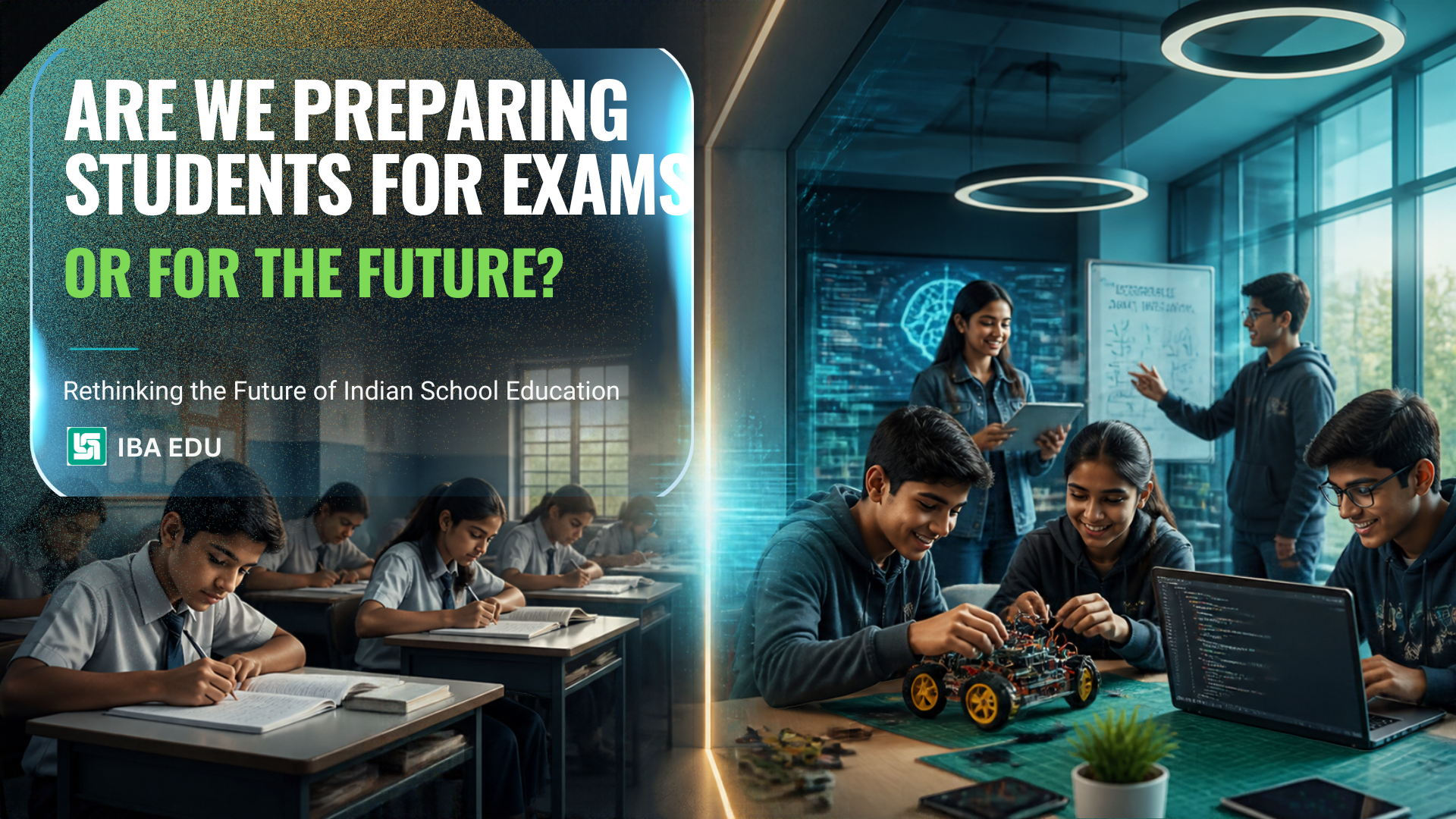
Imagine a student who consistently scores 95% in examinations but struggles to present an idea confidently, manage a budget, solve an unfamiliar problem, build a product or identify a business opportunity.
Now imagine another student who may not always top the class but can identify problems, think independently, communicate effectively, use technology creatively and turn ideas into practical solutions.
Who is better prepared for tomorrow's world?
This is a question every school owner, principal and education administrator must seriously consider.
For decades, academic performance has been the primary measure of school success. But the world students are entering is changing dramatically. Artificial intelligence, automation, advanced manufacturing, digital businesses and emerging technologies are transforming careers and creating entirely new opportunities.
The real challenge is no longer just educating children. It is preparing them to become capable individuals who can contribute to society, succeed in careers and create opportunities of their own.
01
The Education Gap
The Missing Link Between Classroom Learning and Real-World Readiness
Most schools have structured curricula, qualified teachers, examination systems and extracurricular activities. Yet, many students complete their schooling without sufficient exposure to practical situations.
Consider some fundamental questions:
- Can students confidently communicate and present their ideas?
- Do they understand money, budgeting, savings and basic financial decisions?
- Have they experienced designing, building or selling a product?
- Can they identify a real-world problem and develop a solution?
- Do they understand how businesses operate?
- Can they use AI and digital tools to create something meaningful?
- Have they explored different industries and career opportunities?
- Can they work independently, collaborate and take responsibility?
These are not skills that students should discover only after entering college or starting their first job. They should begin developing them during their school years.
According to NITI Aayog's 2026 report, Reimagining Skilling for Viksit Bharat@2047, fewer than one in twelve secondary schools offer vocational subjects. The report highlights the need to integrate employability and entrepreneurship skills into school education.
This is a significant gap between India's educational ambitions and implementation on the ground.
02
Global Learning
What Can India Learn from a Developed Neighbouring Asian Nation?
One of the most important lessons in education-led economic development comes from a developed neighbouring Asian nation that has transformed itself into a global powerhouse in manufacturing, technology and industrial innovation.
Its transformation was not achieved overnight, nor was it the result of education reforms alone. It involved decades of coordinated investments in infrastructure, technology, research, industrial development and skilled human resources.
However, one particularly important part of this journey deserves attention: its deliberate investment in vocational education, technical capabilities and industry-linked learning.
Over the last decade, this nation has significantly strengthened its vocational education ecosystem, connecting educational institutions with industries and creating opportunities for students to develop practical and technical capabilities.
Its education and industrial development initiatives have focused on:
- Strengthening technical and vocational education alongside conventional academic learning.
- Establishing partnerships between educational institutions and manufacturing industries.
- Creating practical training opportunities in robotics, electronics, engineering and advanced manufacturing.
- Encouraging students to develop technical expertise, problem-solving abilities and workplace readiness.
- Connecting classroom learning with real industrial requirements.
- Promoting innovation, entrepreneurship and technology-driven economic development.
Its vocational education reforms have also strengthened collaboration between schools, enterprises and training institutions, recognising that employability and technical capabilities must be developed through practical exposure.
A country cannot become a global manufacturing and technology leader merely by producing academically qualified graduates. It must develop a workforce that knows how to design, build, operate, innovate and solve problems.
Indian schools should learn from this approach.
Students should not simply read about technology, manufacturing, business and innovation in textbooks. They should experience how industries work, understand how products are created, explore how businesses operate and develop the confidence to contribute to the economy.
The real opportunity is to connect education with the world students will eventually enter.
03
The Way Forward
What Should Indian Schools Adopt to Become Future-Ready?
Indian schools do not need to wait for a complete education system overhaul. They can begin with structured changes in the way students learn.
01
Practical and Project-Based Learning
Move beyond explaining concepts. Encourage students to design models, build prototypes, conduct experiments, develop digital products and solve real-world challenges.
02
Entrepreneurship and Business Thinking
Introduce age-appropriate activities involving identifying problems, developing solutions, understanding customers, calculating costs, pricing products and presenting business ideas.
03
AI and Digital Creativity
Students must learn to use AI responsibly, understand digital technologies, develop creative solutions and become creators rather than passive consumers of technology.
04
Manufacturing and Vocational Exposure
Introduce students to product design, materials, tools, quality control, assembly and manufacturing processes. Organise visits to factories, workshops, technology centres and local businesses.
05
Life Skills and Financial Literacy
Make communication, teamwork, leadership, decision-making, financial awareness, adaptability and responsibility part of regular learning.
06
Industry and Community Partnerships
Invite entrepreneurs, engineers, designers, professionals and skilled workers to mentor students. Create opportunities for industry visits, demonstrations and practical challenges.
07
Career Discovery from an Early Age
Expose students to different professions and emerging career opportunities. Help them understand what people actually do in different industries, rather than limiting career awareness to conventional professions.
04
Leadership Transformation
The Biggest Transformation Required Is in the School's Mindset
Introducing an AI lab, conducting an annual science exhibition or organising one entrepreneurship competition does not automatically make a school future-ready.
The real transformation begins with school leadership.
Principals and administrators must move from asking:
- How many students scored above 90%?
- How many competitions did we conduct?
- How many activities did we complete?
To asking:
- What can our students independently create?
- Can they solve unfamiliar problems?
- Have they experienced real-world applications of classroom learning?
- Can they communicate, collaborate and lead?
- Have they developed entrepreneurial thinking?
- What practical capabilities have they acquired this academic year?
This requires a behavioural change across the institution.
School management must encourage experimentation instead of focusing exclusively on perfect answers. Teachers must become facilitators of discovery, not merely transmitters of information. Parents must recognise that practical capabilities are as important as examination results. Students must be encouraged to question, explore, experiment and learn from failure.
Future-skills education should not be treated as an annual event or an additional extracurricular burden. It must become part of the school's learning culture.
05
Policy to Practice
India Has the Policy. Does Every School Have the Implementation?
India's National Education Policy 2020 already provides a strong foundation for this transformation.
It recommends vocational exposure from Grade 6, internships, experiential learning and reducing the separation between academic and vocational education.
In August 2024, the Ministry of Education introduced guidelines for ten bagless days for students in Grades 6–8, encouraging exposure to local professionals, craftspeople and practical skills.
Yet, the challenge remains translating policy recommendations into consistent school-level experiences.
A school may have a well-designed academic curriculum but lack a structured framework for developing practical skills. It may conduct activities without measuring what students actually learn from them.
The missing element is often not awareness. It is a clear implementation roadmap, teacher readiness, institutional ownership and measurable outcomes.
06
School Self-Assessment
How Can Schools Identify Their Future-Readiness Gap?
Before investing in new infrastructure, programmes or technologies, every school should understand where it currently stands.
A structured assessment should examine seven important dimensions:
01
Future-Skills Integration
Are practical and employability skills part of the learning experience?
02
Career Readiness
Are students exposed to industries, professions and emerging careers?
03
Entrepreneurial Mindset
Are students encouraged to identify problems and develop solutions?
04
Digital and AI Readiness
Are students learning to use technology responsibly and creatively?
05
Life Skills
Are communication, leadership, teamwork and financial literacy developed?
06
Experiential Learning
Do students regularly participate in hands-on projects and real-world activities?
07
Institutional Readiness
Are teachers, school leaders and management committed to continuous improvement?
Schools should be able to evaluate these dimensions through simple, structured self-assessment questions supported by examples of existing practices and student activities. Confidential financial or internal institutional documents should not be necessary.
The objective is to identify strengths, uncover gaps and understand where meaningful improvements are required.
07
IBA EDU Initiative
A New Initiative to Recognise and Develop Future-Ready Schools
IBA EDU is working towards a National Future-Ready Schools Rating & Recognition Initiative, focused on encouraging schools to evaluate how effectively they prepare students for the world beyond examinations.
Through a structured school self-assessment questionnaire, participating institutions will have an opportunity to evaluate their existing practices across practical learning, life skills, career awareness, entrepreneurship, AI readiness, innovation and experiential education.
The initiative aims to:
- Recognise schools demonstrating meaningful commitment to future-ready education.
- Identify institutional strengths and opportunities for improvement.
- Encourage the adoption of practical, skill-based learning.
- Promote innovation and entrepreneurial thinking among students.
- Create awareness about measurable student development beyond academic scores.
The objective is not simply to rank schools. It is to encourage schools to understand where they stand today and what they can do better tomorrow.
IBA EDU | Future-Ready Schools
Is Your School Ready for the Future?
Academic excellence is important. But preparing students for careers, entrepreneurship, innovation and real-world challenges is equally essential.
Take the first step towards understanding your school's future-readiness and discover opportunities to strengthen student development beyond examinations.
Join IBA EDU's Future-Ready Schools initiative.
Explore Future-Ready Schools Assessment →A Vision for Tomorrow
The Future Workforce Is Sitting in Today's Classrooms
India has the talent, demographic strength and ambition to become a global leader in technology, innovation and manufacturing.
But this ambition cannot be achieved by producing students who only know how to reproduce information in examinations.
We need students who can think, design, build, communicate, innovate, adapt and create opportunities.
The responsibility does not belong to governments alone. School owners, principals, administrators, teachers, parents and industry partners all have a role to play.
The question is no longer whether schools should change. The question is whether school leadership is willing to recognise the gap and take the first step.
Because the future workforce is sitting in today's classrooms.
And the future of India depends on what we prepare them to become.
An initiative by IBA EDU | Building Future-Ready Schools and Future-Ready Students.
