
Currently Empty: ₹0.00



Blog
Beyond AI Tools: How the IBA EDU AI Future Creators Program Is Changing the Way Children Think, Create and Solve Problems
- October 23, 2026
- Com 0
Beyond AI Tools: How Children Learn to Think, Create & Solve Problems
How brain-first AI learning helps school students turn everyday observations into innovative ideas, transform academic subjects into interactive projects, and develop the mindset to create with purpose.
Brain First. AI Next. Creativity Always.🧠Think Before Prompting
💡Turn Ideas Into Projects
🚀Create With Purpose
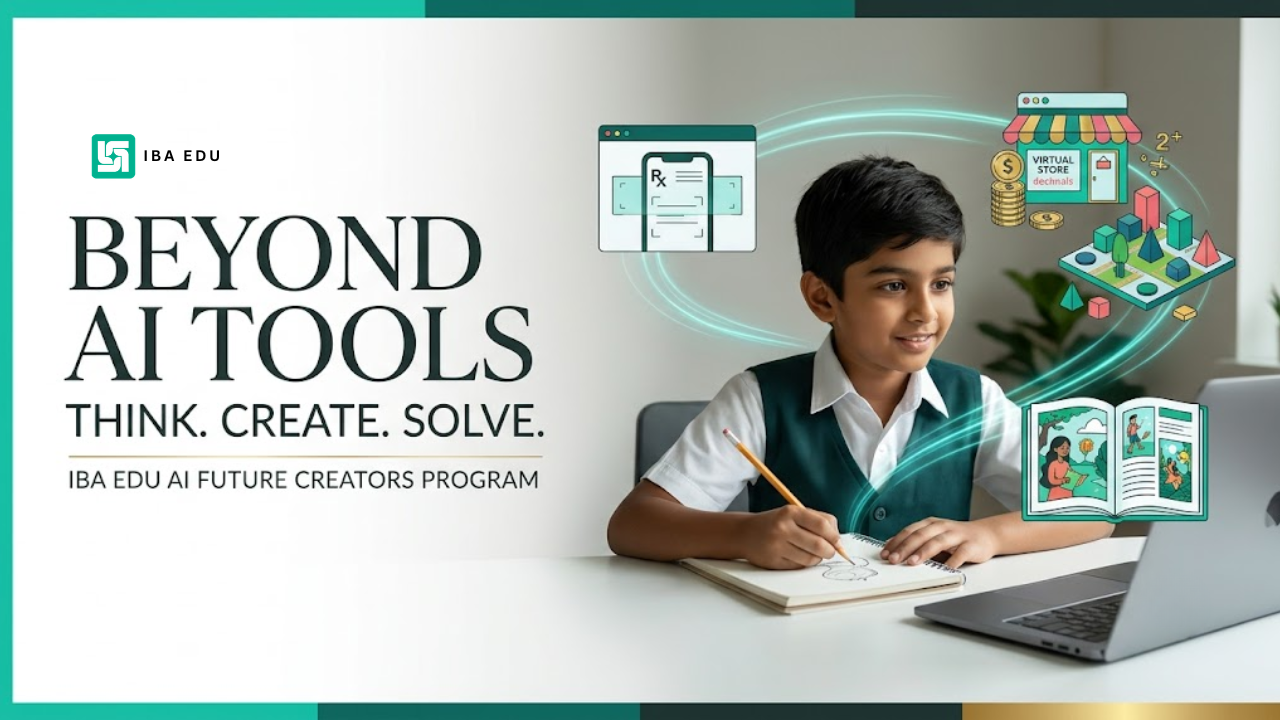
What if a six-year-old could look at a doctor's prescription and see more than difficult handwriting? What if a Mathematics lesson could become a game, a virtual store or an interactive city planner? These examples capture a bigger shift in education: helping children move beyond using AI tools to thinking critically, creating meaningfully and exploring solutions.
A Six-Year-Old Who Saw a Problem Worth Solving
One of our youngest students, just six years old, encountered an everyday problem during a visit to the doctor. After receiving a prescription, she noticed that she could not understand the doctor's handwriting. She asked her mother why prescriptions were sometimes so difficult to read.
But her curiosity did not stop there. She began thinking about what could happen if someone who could not read the prescription received the wrong medicine because the handwriting had been misunderstood.
She brought this concern into her learning environment at IBA EDU. With guidance, she began exploring an application concept that could scan a prescription, help interpret its contents in a regional language and support users in cross-checking the medicine being dispensed.
The child identified the problem. AI became a tool to explore a possible solution.
The significance was not simply the application idea. It was the thinking journey behind it: she observed a problem, questioned its consequences, considered the people affected and explored how technology might help.
Important: This is an educational concept, not a clinically validated medical product. Any real-world prescription-reading or medicine-verification application requires rigorous testing and qualified healthcare professional oversight. AI must not replace a doctor or pharmacist.
When Mathematics Becomes Something Students Can Create
Our students have also explored ways to turn academic concepts into interactive experiences. Instead of approaching Mathematics only as formulas and exercises, they have created projects that connect ideas to familiar situations.
🧮
Calculator Games
Students turn calculations into interactive challenges, thinking through the mathematical operations, game rules and how a player will use the experience.
🛒
Virtual Store Games
Prices, quantities, purchases and decimals become part of a familiar setting where students can explore mathematical operations through practical scenarios.
🏙️
City Planner Games
Students explore area, perimeter and volume while planning buildings and spaces—connecting measurements with design choices and real-world applications.
The objective is not to use AI to complete Mathematics for students. It is to use AI as a creative aid while students engage with the concepts behind their projects. Creating also gives them opportunities to explain their reasoning, test their ideas and revisit what they are learning.
Why We Encourage Students to Think Through Stories
Storytelling is an important part of our approach. When students explain a concept through a story, they must think about how the idea begins, how its parts connect and how to communicate it meaningfully.
As they create, questions naturally emerge: Does this explanation make sense? Why does this happen? What if I change this part? Is the information correct? How can I explain it more clearly?
These questions create opportunities for deeper engagement. Students can use stories to explain academic concepts, develop digital storybooks, create videos and communicate ideas visually. They can also discover gaps in their understanding while attempting to explain something to another person.
Understand it. Question it. Express it. Create with it.
Our aim is to make learning more active—connecting knowledge with curiosity, expression and practical application.
From AI Users to Thoughtful AI Creators
There is a meaningful difference between asking AI to generate an answer and using AI to develop an original idea. A student who simply copies an output may finish quickly without understanding it. A student who identifies a goal, plans an approach, evaluates the output and improves the result has a different learning experience.
1
Think
Notice something, identify a need or clarify the goal.
2
Question & Plan
Ask useful questions and decide what the project should do.
3
Prompt & Create
Use AI purposefully to explore, design and build.
4
Test & Improve
Review outputs, correct mistakes and explain the result.
Students are encouraged to understand that AI outputs need to be reviewed, ideas can be refined and the creator remains responsible for the final work. This creates opportunities to discuss accuracy, originality, responsible use and human judgement.
What Makes the IBA EDU AI Future Creators Program Different?
The IBA EDU AI Future Creators Program is built around a simple philosophy: develop the child's thinking first, then use AI to make that thinking more powerful. The focus is not just on learning tools, but on applying creativity, knowledge and problem-solving to meaningful projects.
✓
Think independently
Observe, question and explore before reaching for an AI tool.
✓
Create with purpose
Turn ideas into games, storybooks, posters, videos and presentations.
✓
Apply school knowledge
Connect Mathematics, Science, English and Social Studies with practical creations.
✓
Explore real problems
Identify challenges and investigate possible solutions.
✓
Review and improve
Evaluate AI outputs, test ideas and refine projects.
✓
Communicate confidently
Explain projects and share the thinking behind each creation.
For parents, this offers an approach to introducing children to AI with an emphasis on creativity, thoughtful use and learning. For schools, it creates opportunities to connect classroom knowledge with project-based learning. For students, it opens up a different way to see the world—not simply as something to learn about, but as something to question, understand and improve.
The Future Belongs to Children Who Can Turn Ideas Into Reality
The six-year-old who questioned a doctor's prescription and the students creating Mathematics games represent two sides of the same learning philosophy. One began with a real-world problem. Others began with concepts from their school curriculum. Both approaches begin with thinking.
This is not a promise that every child will become an entrepreneur or inventor. It is an opportunity for learners to practise curiosity, creativity, problem-solving and responsible technology use.
“What problem can I solve? What can I create? How can I make this better?”
The Future Creator MindsetThese are the questions we want children to feel confident asking—not because AI has all the answers, but because children can learn to explore better questions and take ownership of their ideas.
Ready to Help Your Child Become a Future Creator?
The IBA EDU AI Future Creators Program invites students to explore AI beyond prompts and tools—to think, create, apply knowledge and turn ideas into projects.
Brain First. AI Next. Creativity Always.
